
In the heart of Auroville’s lush landscape, a remarkable approach to construction unfolds. Auroville’s earth-centric building techniques showcase a profound harmony between human habitation and the natural world. Join us in exploring the innovative construction methods that make Auroville a global leader in eco-conscious living.
Continue readingAuroville’s Water Harvesting Techniques: Lessons for a Drier World
Amid the arid landscape of Auroville, an oasis of water sustainability thrives. Auroville’s innovative water harvesting techniques serve as a beacon of hope in a world facing increasing water scarcity. Join us on a journey to discover the wisdom and lessons Auroville offers for communities grappling with the challenges of a drier world.
Continue readingProtecting Groundwater in Auroville: The Importance of Sustainable Practices
Auroville, nestled in the heart of Tamil Nadu, India, is a shining example of sustainable living. Its commitment to groundwater protection is not just about safeguarding a resource; it’s about ensuring a sustainable future. Join us in exploring how Auroville’s innovative practices and deep reverence for groundwater set a powerful example for communities around the world.
Continue readingFrom Waste to Resource: Auroville’s Innovations in Water Management
In the heart of Auroville, a revolution is taking place in the realm of water management. Auroville’s innovative approach transforms wastewater into a valuable resource, showcasing a model of sustainability that can inspire the world. Join us on a journey through the groundbreaking water management practices that are making Auroville a global leader in turning waste into a precious asset.
Continue readingAuroville’s Sustainable Approach to Earth and Water Conservation
In the heart of Auroville, a remarkable experiment in sustainable living is underway. Auroville’s commitment to earth and water conservation is not just an aspiration; it’s a way of life. Join us on a journey through the innovative strategies and practices that make Auroville a shining example of sustainability in action.
Continue readingLine of Goodwill

The Gateway/Habitat/Matrimandir/Visitor Access
Background
Auroville, the ‘City the Earth Needs,’ is a universal township in the making, based on the evolutionary
vision of the Indian seer, Sri Aurobindo and his spiritual partner, Mirra Alfassa, known as the Mother.
The goal of Auroville is to realize Human Unity. Through research and discoveries Auroville strives to
become a living embodiment of an actual living Human Unity.
The Mother initiated a city plan for 50,000 where people from all over the world could learn to live and
work together in unity. To achieve this in a 2.5 km radius the innovative Lines of Force came into being
to manage density with a balanced, free flowing environment.
Three projects have come together to realize the longest Line of Force, Line of Force-1, the Line of
Goodwill: The Gateway of Human Unity, Matrimandir Visitor Access and Goodwill Habitat.
Goodwill Habitat: Auroville’s present population stands at approximately 3000 and there is an urgent
need for growth. Corresponding habitat for the growing population will have to be built to allow for
the new energy and resources that the city needs to fulfill its aims.
Auroville, the ‘City the Earth Needs,’ is a universal township in the making, based on the evolutionary
vision of the Indian seer, Sri Aurobindo and his spiritual partner, Mirra Alfassa, known as the Mother.
The goal of Auroville is to realize Human Unity. Through research and discoveries Auroville strives to
become a living embodiment of an actual living Human Unity.
The Mother initiated a city plan for 50,000 where people from all over the world could learn to live and
work together in unity. To achieve this in a 2.5 km radius the innovative Lines of Force came into being
to manage density with a balanced, free flowing environment.
Three projects have come together to realize the longest Line of Force, Line of Force-1, the Line of
Goodwill: The Gateway of Human Unity, Matrimandir Visitor Access and Goodwill Habitat.
Goodwill Habitat: Auroville’s present population stands at approximately 3000 and there is an urgent
need for growth. Corresponding habitat for the growing population will have to be built to allow for
the new energy and resources that the city needs to fulfill its aims.
The Gateway: Many people and institutions all over the world are working towards the goal of unity
in diversity and the aim of the Gateway of Human Unity is to serve as a bridge between the World
and Auroville and to host the meeting between the two. By creating a meeting place, Auroville is
committed to learning from the discoveries and insights from without and to sharing the discoveries
and insights learned from within.
Matrimandir Visitor Access: Auroville presently receives more than 700,000 visitors every year and the
number is increasing. The majority of these visitors come to see the Matrimandir.
As Matrimandir and the Park of Unity including the Lake are moving towards completion new more
permanent arrangements have to be made to receive all these visitors according to the guidelines
given by The Mother.
Arrangements for receiving visitors to Matrimandir have been provided for in the Auroville Master Plan
along the axis of the Line of Goodwill.
Line of Goodwill
Unlike other cities, Auroville starts from the centre, the Peace Area. It houses the Matrimandir, the
soul of the city, which is to be surrounded by a lake. The city radiates from this centre according to the
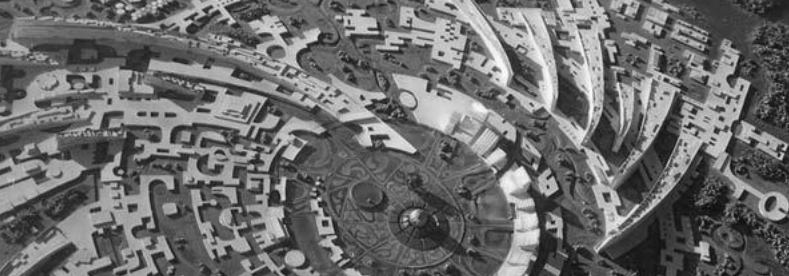
Galaxy plan which is defined by 12 Lines of Force. The Western Line of Force or Line of Force 1, named
the Line of Goodwill, is the longest of these Lines.
Line of Goodwill
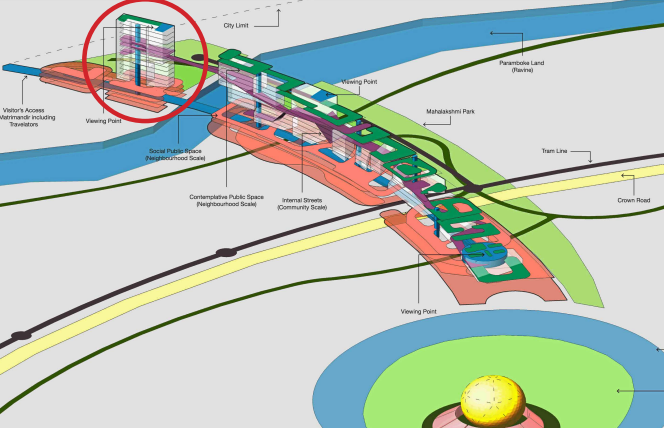
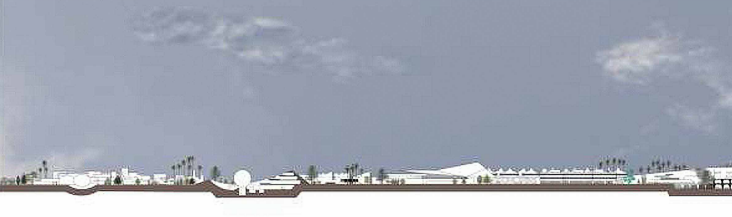
Spanning over 800 meters and it connects the West Entrance of Matrimandir at the Lake to The
Gateway, at the far end, while integrating the Matrimandir Visitor Access and the Goodwill Habitat
along its length. This Line of Force is an integral part of the Galaxy Plan.
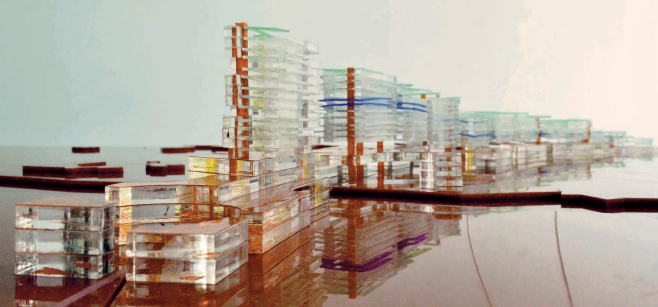
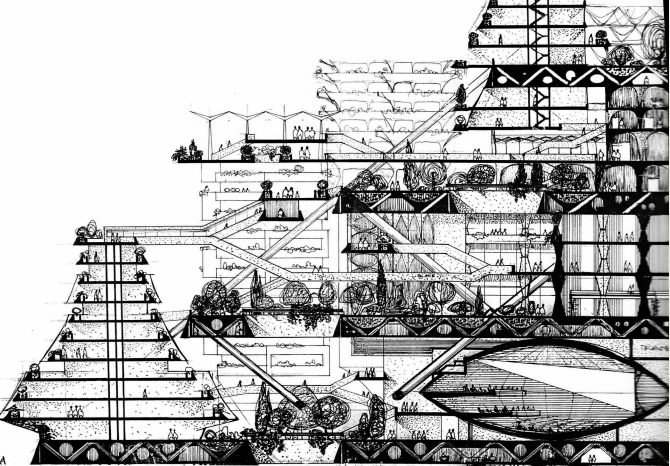
The profile of the Line of Goodwill is envisaged as a rising hillscape, where one can walk through
rooftop gardens from the lowest areas of interconnecting Habitat clusters, starting from the Lake at
the West Gate of Matrimandir to the highest level, 18 stories, at the Gateway.
The Line of Goodwill will be porous with a 45% void to built-up ratio, full of open spaces and open to
the surrounding nature.
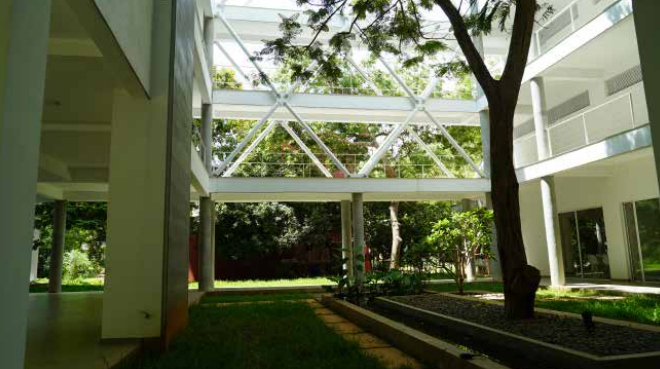
The Line of Goodwill wants to be a green building in every sense, including the integration of nature
(wind, water, renewable energy, plants) into its design and fabric.
The Line of Goodwill aspires to apply cutting edge alternative energy technologies minimizing the
carbon footprint even in the construction phase.
From the point of view of Auroville, building the Line of Goodwill is an opportunity to build in the
spirit of experimentation and innovation with all-inclusiveness and collaboration within Auroville and
between Auroville and the rest of the world.
It is seen as a prototype for building the “City the Earth Needs” which implies the highest standards of
ecological and environmental sensitivity both towards man and nature in the design, the execution
and the realized project honoring the immense amount of work already done to regenerate its land
and environment by Auroville.
It is seen as a prototype building for the “City the Earth Needs” which implies the highest standards of
ecological and environmental sensitivity both towards man and nature in the design, the execution
and the realized project honoring the immense amount of work already done to regenerate its land
and environment by Auroville.
Habitat
Situated in Auroville’s Residential Zone, the Line of Goodwill must fulfil its objective of managing
density and house up to 8000 people. Starting from the Matrimandir Lake front at Ground level, the
Goodwill Habitat will gradually rise in height till it reaches a natural canyon at G+14 beyond which lies
the Gateway.
A Conscious Coexistence
The project calls for a new type of housing reflecting Auroville’s unity in ways that are both material
and spiritual and create inventive bridges with the past and the future. It will concentrate urban living
patterns and contemporary arrangements with a conscious use of new technologies while nurturing
an inner soul space and a coexistence with humanity and nature. It will manage resources consciously
and create artistic environments for a society to grow harmoniously as in ancient traditions.
As a prototype for coexistence the Goodwill Habitat will welcome people of all national, social and
economic backgrounds, embrace the diversity of local and global strata, all languages, age and gender
so that people can learn to live together in harmony.
The Goodwill Habitat will develop in a phased way together with Gateway and the
Matrimandir Accessway, starting with a first phase for 500 people.
Housing a New Society
Auroville will be a site of material and spiritual researches for a living embodiment of an
actual human unity.
Habitat will provide individual housing and collective social spaces that are simple, rich, beautiful and
conscious.
At Ground level Habitat will face the Matrimandir Lake, where it will offer a contemplative space, like a
meditative tea room, a place to experience beauty.
Levels 1 to 4 will be more social and collective and offer all the amenities like a reception, collective
kitchens and restaurants, inner gardens and courtyards, libraries, lounges, offices, creche and play
areas, stores for basic needs, health facilities, laundries and guest facilities.
A Community Plaza is envisaged at level 4, with an indoor amphitheatre, auditoriums and exhibition
spaces plus administrative and maintenance sections for the whole Habitat.
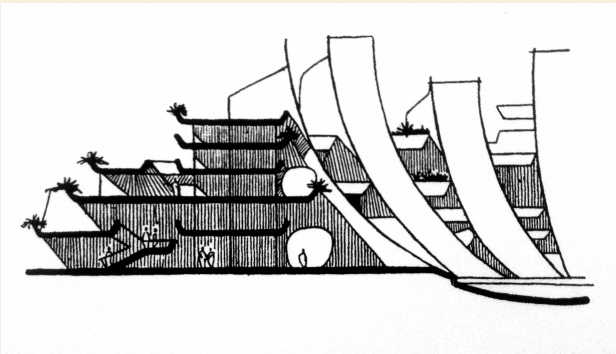
As levels rise the building will grow more porous, quieter and private, allowing a free and contemplative
atmosphere. Habitat will be interconnected with gardens, ponds and pathways from ground level to the
roof and across its horizontal span with private, semi-private and public circulations.
A diversity of apartment designs is envisaged for singles, couples and families, student groups and
guests. Common areas will remain open as study spaces for children in this city of unending education.
Care will be taken in design not to stack people in apartments in an impersonal manner but offer a
flow of open spaces, as has been tried at Sunship, integrating the beauty of the environment with the
atmosphere of Auroville and its Soul.
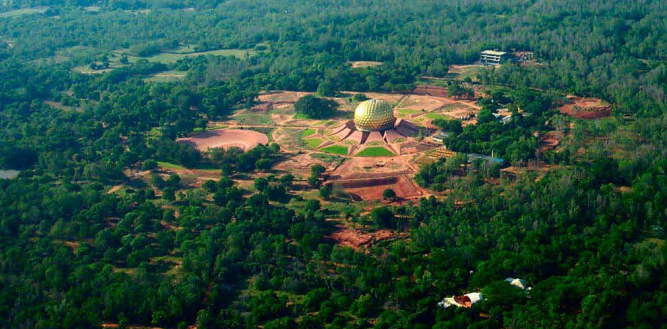
Earth. Wind. Water. Solar.
The Goodwill Habitat wants to serve as an exemplary model not just for Auroville but also as a prototype
of a sustainable, collective coexistence for India and the world through best practices in urban planning
with the environment, through architecture and design and by creating new models for collective habitat.
Earth: Economic land use. Sensitive integration with surrounding environment. Green shafts between
buildings. Urban farming on the roof. Responsibility towards the earth.
Wind : Architecture will be climate responsive, avoiding air conditioning except in collective spaces and
for special health needs.
Water : Conscious use of this resource. Rain water harvesting. Waste water recycling.
Solar: Solar energy panels on roof to capture most of the energy and back up for the building
Waste Management: Sewage recycling to be integrated in the building design. Proper waste
management to be planned from the construction stage with the Wasteless Team.
Materials: Study different types of sustainable materials together with lighter high tech possibilities to
keep the building light and porous as it goes higher.
Key Aims: collective, sustainable, experimental, interdependent, self-sustainable.
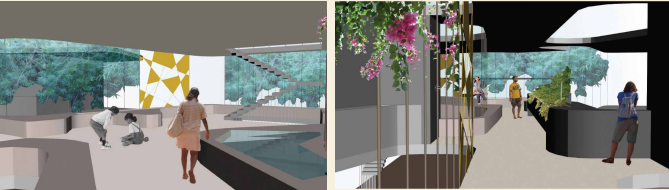
Living Laboratory
Auroville is known as a field of experiment. The Line of Goodwill’s Habitat experiment in collective
coexistence will encourage a paradigm shift in attitudes nurturing a new spirit of sharing, responsibility,
beauty and oneness.
Aims:
- It will eliminate a client-builder relationship.
- Move away from personal ownership towards a collective living.
- Housing and collective spaces will be an asset of Auroville.
- Housing allocation will be decided together with Auroville’s Housing Service.
- Will encourage experiments in areas of culture, education, architecture and environment.
- Will offer some facility or service for Auroville’s collective use like laundries, the
community plaza, study spaces and offices and welcome guests. - Encourage the growth of unique urban streets and enable different types of mobility :
pedestrian, cycle, and a monorail station in the Crown junction.
Beauty
This manifestation of beauty and harmony is part of the Divine realization upon earth,
perhaps even its greatest part…
Art is nothing less in its fundamental truth than the aspect of beauty of the Divine
manifestation.
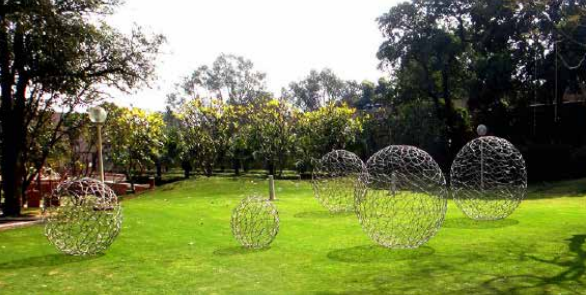
Artistic zoning in both private and social spaces will be an integral part of the project design and
atmosphere.
Fraternal Funding
Auroville is an international project for humanity as a whole. It is an invitation for all those who thirst
for progress and aspire to a higher and truer life. People are drawn to Auroville as the world changes
rapidly and the city has to be prepared to house them
Not everyone can live in Auroville physically, but all can participate in different ways to help make this
dream a reality. Auroville continues to be built with the help of donations from all those in India and
elsewhere who feel inspired to nurture this experiment.
The Goodwill Habitat hopes to inspire all those who wish to see Auroville manifest by supporting new
models of living that can improve the life of cities qualitatively.
Self Maintenance of Project
To maintain the buildings and the area a Service Team will be created. It will draw from the experience
of projects like Citadines and Sunship that self-manage through monthly service contributions from all
residents as well as fraternal contributions plus alternative donations to ensure its overall maintenance.
Preliminary Budget to accommodate 500 people
in the first phase:
Rs 100 Crore / 15 million Euro
The Gateway
The Gateway is to be one of the first phases of the Line of Goodwill. The Gateway will be the first
point of entry for visitors in their meeting with Auroville. Acknowledging that the World has much to
offer Auroville, Auroville would also like to share insightful journeys towards consciousness, in order
for visitors to take inspiration for their own life journey.
While spiritual journeys are personal, in Auroville the result of these journeys is expressed in many
aspects of life – in everything from daily life and routines, to job creation, production and consumption.
These insights are worth acknowledging and can create a framework for many conversations between
Auroville and Auroville visitors.
In these meetings and conversations the Gateway will allow Auroville to explore and accept all the
goodness happening in the World, while also allowing the visitors to explore Auroville’s ambitions to
contribute to humanity and to human unity.
Through conversations, the Gateway will touch all visitors with the values of Auroville, and
everybody would leave inspired to grow towards a higher consciousness wherever they are
in their life journey. And they will leave with an invitation to return.
Visitors
Everybody is welcome, but not everybody is ready to start on a life-changing
journey. For these visitors The Gateway aims to sow a seed of
understanding of consciousness. These visitors are welcome again to
deepen the conversation when they are ready to. The Gateway aims
primarily to attract visitors curious to and possibly on their journey
towards spirituality, consciousness, and a better world: Unity in
diversity. In joint efforts, conversations between these visitors and
Auroville will accelerate the process towards Auroville’s goals and values in an effort to serve humanity.
Outreaching communication should focus on preparing and conditioning the visitors, so they are
receptive for the meeting and what Auroville is offering. Equally it should prepare Auroville for those
visitors that have something at heart they’d like to bring to Auroville.
The Gateway obligations
The Gateway would offer activities to support a two-way dialogue. Being the host, the Gateway is
also responsible for formats to securing the dialogue to remain proper, non-judgmental and based in
goodness.
The objective to have a dialogue approach to meeting the visitors is to avoid condescending attitudes
and to invite openness and willingness to listen and learn and co-create insights.
Atmosphere and Guidance
The whole of the Line of Goodwill will be a physical metaphor where the material structure and its
usage reflect the spiritual principles of Auroville. The higher one ascends in the buildings the quieter
and more contemplative the atmosphere created. The further in one goes the more intimate the
connection with Auroville and its Soul.
Where the Matrimandir is emotional and pure in is architectonic communication on the outside and
rational, simple and clear on its inside, the Gateway would be perceived opposite: Rational, simple
and clear outside while allowing for emotional complexity inside, hosting many different activities
and experiences. Yet, the inside of the Gateway should impose feelings of serenity, inducing awe
and humbleness. The architecture of the Gateway should absorb visitors, creating an illusion of vast
spaciousness and an impression of uncrowdedness. Silence should be instilled, and visitors should be
invited to experience the power of silence. Ques from semi-conscious elements influence experiences
and help control visitor behavior.
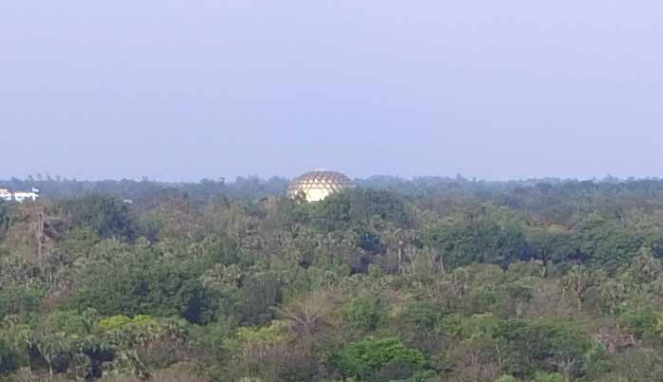
Leading by example, staff will encourage conscious and self-controlled behavior, and sound absorbing
materials will add to the silencing effect.
The Entry Plaza will be a quiet area and will distribute visitors towards activities in the Gateway. Help
will be available in the Plaza to help visitors plan their visit by means of Intelligent signage, e-guidance
system and staffed information desks.
The Gateway will provide access to the Viewing Points and filtered access to a new Matrimandir
Visitor’s Hub within the Line of Goodwill, which will provide all facilities for visitors to Matrimandir.
Conversations Inside the Gateway
Creating a sense of endless opportunities, conferences and seminars will always be ongoing. It will
always be worthwhile to return to Auroville.
Conversations with the visitors will predominantly be curated and structured in the form of workshops,
seminars and conferences. Visitors will also be invited to leave their mark, for example by sharing
thoughts, ideas or images to be displayed inside the Gateway.
Invitations will be extended to progressive thinkers, philosophers, activists, artists and thought-leaders
to conduct workshops in alignment with Auroville values. Other organizations that are working towards
Human Unity could also be engaged to conduct conferences and seminars in collaboration with
Auroville.
Elaborate Wellness seminars for consciousness, mind and body, would create reasons to assemble the
World’s best minds artists and implementers.
Tying into Auroville Values, learning workshops could include: coaching and well being, sustainability,
and social awareness and will include all the experience of the social enterprises of Auroville.
Integral Yoga would inspire seminars grouped under two headings:
- Balancing your inner self exploring effects on parenting, wellness and psychological wellness.
- Interacting in societies and social life leading towards benefits for humanity and Human Unity.
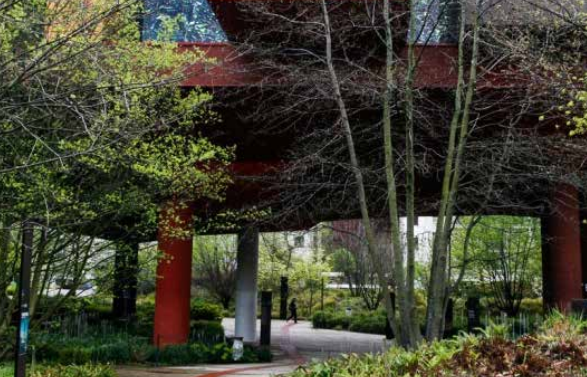
All experience and healing oriented Auroville Units will have central place and role in creating and
executing conversations and interaction with visitors.
Living Laboratory
- “Auroville will be a site of material and spiritual researches for a living embodiment of an actual
human unity.” - Auroville is well known both in India and the world at large for its integral approach to Education,
Environment, Reforestation, Organic Farming, Architecture and Appropriate Building Technologies,
Alternative Energy, Health and Healing, Culture, Creativity and Commerce. The Gateway aspires to
consciously create a platform which will display these areas of excellence and Auroville talent in their
full potential. - The future for Auroville lies in its strengths of being a “melting pot” of cultures and ideas, its
strong interest in research and development and its wish to be in the forefront. Fueled by India’s
accelerated development it is now moving into a Knowledge Economy with a high complexity of
consumer demands including increasing consciousness of sustainability and social awareness, and yet
demanding products with a high content of design and knowledge driven by Auroville’s values. Many
units are already delivering solutions and ideas that the respond to these demands and the Gateway
will serve as a platform to present these products.
Retail and restaurant space
For Auroville retail, the space should fuel exploration, discovery and inspiration
Retail and eating space will be spread out so that it does not jeopardize the serenity of the
conversation space in The Gateway.
Auroville has many facets and below are some of the activities that will be part of Gateway:
Education
Research
Vocational Training
Volunteering
Internships
Sustainability
- Energy
- Environment
- Water
- Appropriate Building Technologies
- Waste and Recycling
- Organic Farming
- Reforestation
Incubation - Design lab
- Workshops
Health & Wellness - Alternative Treatment and Healing
- Therapies
- Music/Bodyworks
- Awareness through the Body
- Yoga
- Spas
Workshops
- Environment
- Waste and Recycling
- Cooking and Nutrition
- Pottery
- Natural Dyeing
- and many more
Design/Architecture/Landscaping
Hospitality - Hotel
- Dormitory
- Wide range of Eateries
Recreation - Surfing
- Riding
- Walks
- Cycling
The Gateway will interweave Art and Beauty into all its spaces. There will be large beautiful spaces
for Conscious Retailing, Events and Exhibitions. There will be Conference Facilities for cutting edge
meetings and networking to bring top participants in chosen fields from all over the world. This will
create an Integral Auroville Experience for visitors.
The Gateway will have the capacity to give immersive multi-faceted experiences to visitors coming to
Auroville over several days, to attract actively engaged people from all over the world and to deliver
fully rounded experiences of Auroville’s spirit including spirituality, humanity, community, environment,
excellence and progress.
Gateway Business Plan
The Gateway is a large scale multi diverse project, which will contain and showcase all aspects of
Auroville: production, consultancy, education, healthcare, art, exhibitions, hospitality etc.
The Gateway has two aspects. Participants with a commercial aspect will contribute and in this way
provide for the public spaces, exhibition areas, education and other interests which will provide the
integral Auroville experience.
The cost of Gateway is presently estimated at Rupees 130 crore. The intention is that it will be fully
externally financed by donations and soft loans which do not require collateral.
This cost, financed over 15 years at 10% interest rate with fixed annual payment, would mean a
paying back of Rupees 17 crore every year over 15 years.
Projected Income per year (2018 value): Indian Rupees
Viewing Lift for Visitors Going to the Roof Garden : 5.5 crore
Hotel and Dormitory : 5.0 crore
Income from turnover of retail/eateries, etc: 24.0 crore
Total : 34.5 crore
Projected cost per year (2018 value):
Staff management of 150 people : 5.0 crore
Electricity, water, generator, maintenance, etc : 8.0 crore
Interest and repayment : 17.0 crore
Total : 30.0 crore
The Gateway budget will from the start provide a substantial income to Auroville’s central fund and
when the loan gets repaid the Gateway will be an economic dynamo for Auroville’s collective economy.
Matrimandir and the Gateway
The Gateway will be the first point of entry into Auroville for all Visitors, including all visitors to
Matrimandir. At the Gateway visitors will be offered an introduction to Auroville, its activities and its
values. This will be done by creating an integral experience where visitors can dive into the many
aspects and facets of Auroville.
It is at the Gateway that visitors will find exhibitions and videos on the history and the purpose of
Matrimandir.
Practical guidance will also be on hand as to how to access the scenic pathways to the roof-top
Viewing Points on the Line of Goodwill and where to go to make bookings to visit the Inner Chamber.
At the Gateway there will be a special reception lounge, with videos facilities, for the significant
number of special guests Auroville and Matrimandir receive every day wishing to visit the Viewing
Points or the Inner Chamber.
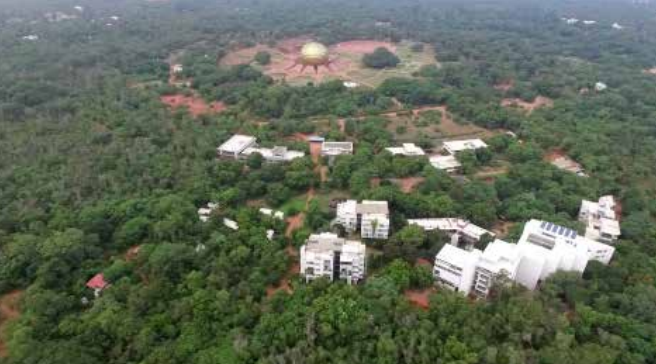
Matrimandir Viewing Points
Viewing Points for Matrimandir and the Park of Unity will be placed on the roofs of the Line of Goodwill.
Two Viewing Points are envisaged.
From the roof at the level of the Crown at 12 storeys there will be a panoramic Viewing Point of all
Auroville including Matrimandir and the Park of Unity.
From a height of 6 storeys there will be a more intimate Viewing Point of Matrimandir and the Park of
Unity.
Access to the Viewing Points will be by scenic walk ways slowly rising through the buildings of the Line of
Goodwill from the Gateway.
These walkways will be isolated from the walkways used by the residents of the Habitat and will not
disturb them.
The walkways will be designed to be accessible for all with electric vehicles for the handicapped available.
The walkways will be designed as both exhibition space and nature walk.
The walkways will be designed in such a way as to naturally bring an atmosphere of quietness and
inwardness without codes of conduct having to be imposed.
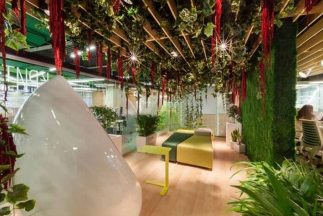
Matrimandir Visitor Hub
Beyond the Gateway and just beyond the peramboke canyon there will be a custom-built facility for
receiving visitors who want to enter the Matrimandir.
Visitors wishing to enter Matrimandir for Concentration for the first time will be directed from the
Gateway to a Booking Office where they will find easy to use booking facilities and all the information
they will need to make their visit to Matrimandir peaceful and trouble free.
Quite separate from the Booking Office, elsewhere in the Hub, there will be the facilities to receive
visitors for Concentration on the day of their visit.
The reception area for visitors for Concentration will contain a check-in hall, a secure left property
facility for all bags, cameras and cell phones and personal comfort services such as toilets and
drinking water fountains.
There will also be a video room where all first-time visitors will be shown videos on Matrimandir,
its history, its purpose and its codes of conduct before they make their way to the Matrimandir
Accessway.
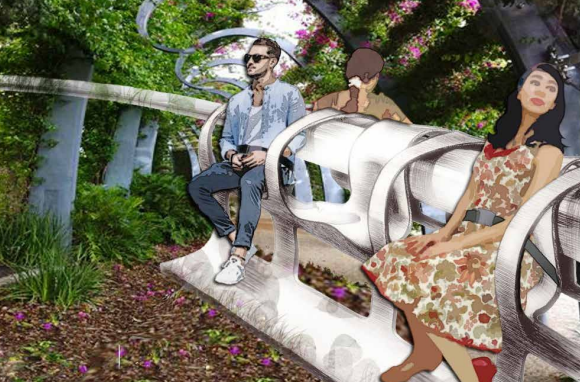
Matrimandir Accessway
Matrimandir is dedicated to minimizing motorized traffic generated by visitors to Matrimandir. All
visitors will leave their vehicles at the main Visitor parking at the city limits. From there visitors will
either walk to Matrimandir or be transported by a custom-designed transit system.
The terminal for the Matrimandir Accessway will be found inside the Matrimandir Visitors Hub and will
only be accessible to visitors with passes for Concentration in the Inner Chamber, visits to the Park of
Unity or events at the Amphitheatre.
The Matrimandir Access Way will consist of a walkway and a transit system with seating for up to
100 people to convey visitors to Matrimandir and the Park of Unity back and forth along the Line
of Goodwill between the Terminal and the Matrimandir Reception Pavilion at the West Gate of
Matrimandir at the Lake.
The Transit System will use alternative energy and be non-polluting, slow, secure and silent. It will be
designed to draw visitors into their own personal inner space as a prelude to their visit to the silence of
the Park of Unity and the Inner Chamber of the Matrimandir.
The Access Way itself will be designed to be beautiful and quiet, to be fully integrated into nature and
have an atmosphere that will naturally illicit quietness and inwardness as visitors take this first stage of
their journey towards the Peace Area.
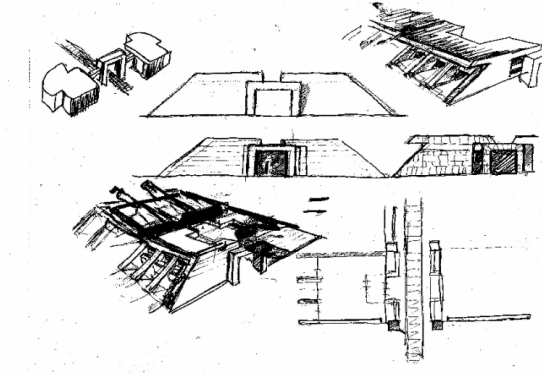
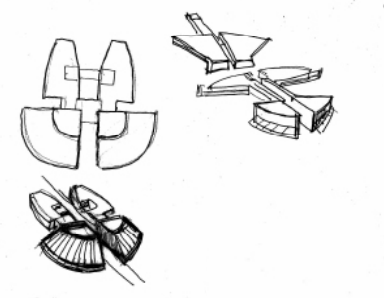
Matrimandir Reception Pavilion
The Matrimandir Reception Pavilion will be found just between the eastern end of the Line of Goodwill
and the Lake at the West Gate of the Park of Unity.
Visitors will reach the Reception Pavilion via the Matrimandir Accessway along the Line of Goodwill.
At the Reception Pavilion visitors will find places to both stand or to sit down and take in the amazing
view of Matrimandir across the Lake.
The Reception Pavilion will be a gathering place for all the groups of visitors going to the Inner
Chamber for Concentration.
And it is here that first-time visitors will receive an inspirational talk on Matrimandir and its higher
significance as well as guidance on codes of conduct from a senior Aurovilian guide.
They will also find comfort facilities such as drinking water fountains and toilets.
The Reception Pavilion will provide similar comfort facilities for staff and Auroville residents entering
the Park of Unity and Matrimandir as well Aurovilians, guests and visitors attending events at the
Amphitheatre, including a secure depository for bags, cameras and cell phones.
Less obtrusively, the Reception Pavilion will also house some offices for return bookings and for the
reception of donors.
There will be an area for the storage and drying of the Matrimandir umbrellas that are handed out to
visitors against the rain or the sun.
There will also be covered parking and charging points for the electric vehicles provided for the use of
the elderly and the handicapped.
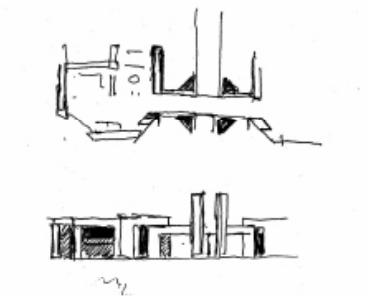
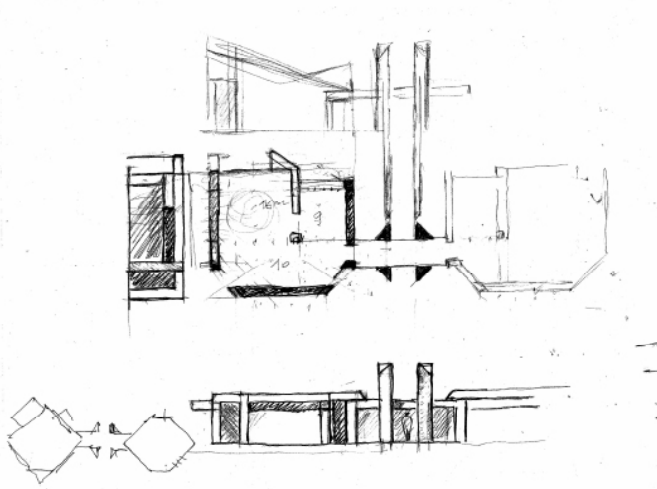
Matrimandir Reception Pavilion Sketches
by Roger Anger
Timeline
Goodwill Habitat, the Gateway and Matrimandir Visitor Access are
now being initiated as part of the Line of Goodwill and will be the
largest project of Auroville once complete.
- A preliminary Urban Design Study of the Line of Goodwill
concepts has be done and letter of Intent has been issued by
l’avenir d’Auroville. - With the permission from L’avenir d’Auroville to source cutting-
edge expertise in all fields relating to environmental sustainability
of the project.
- In collaboration with L’avenir d’Auroville, to invite Auroville and
outside architects, design, technical and resource teams for
environment, landscape, building, waste management and to
come together to set up a collaborative team to work on different
aspects with the help of consultants. - To prepare studies for a unified project design that can
harmoniously integrate a variety of architectural concepts within
clear parameters. - Evaluation of costs.
Matrimandir Next Steps
To complete a first phase study of
architectural design for the Matrimandir
Visitors Hub and the Matrimandir Reception
Pavilion
- To complete a first phase study of the
technical design of the Matrimandir
Accessway and Transit System. - To arrive at a 5 year plan for readiness in
building.
Habitat Next Steps
To prepare studies for a unified project
design that can harmoniously integrate a
variety of architectural concepts within clear
parameters.
- Evaluation of costs.
- To complete a first phase study of
architectural design for 500 people. - To arrive at a 5 year plan for readiness in
building.
Gateway Next Steps
- To invite all Auroville units, service and business and all
activities to become part of the Gateway – their dreams
should become part of the larger dream. - An evaluation and audit of all products, services and
activities that Auroville would like to offer. - An Acceleration Program (a support program to help
units grow and scale up) - A 5-Year plan for readiness.
- Deeper analysis and interaction on creating an integral
Auroville experience catering to a varied public. - The design of the Gateway building and the intention
is to launch an invited architectural competition at the
end of 2018. - The Gateway building would be completed within 4
years by 2023.
Imagining a visit to Auroville in 2030

I had taken a day off from work and was driving down the Highway from Chennai to Auroville. I had been hearing about this place from friends for sometime and was curious to see what this Auroville was all about. It turned out to be just over a two hour drive from Chennai, I was surprised that Auroville was so close.
Turning off the highway I followed a forested road to something called the Gateway. After about a kilometer I finally entered a large parking area. I parked my car, got out and began following the arrows through a leafy park marked Auroville Gateway: City of Human Unity, and suddenly, I saw a tall, minimalist building, rising from the ground in the colours of the earth, gradually softening, growing lighter and more transparent as it reached towards the sky. I stood before it for several minutes, I had never seen anything like this, a building that seemed to carry such a quiet and powerful aspiration, perhaps a dream? I shook myself and kept walking, even more curious now.
I moved through a beautiful landscaped garden towards the big red ramp which led up to a huge opening. Just as I entered the doorway I noticed a small white plaque which said: Greetings from Auroville, to all men of goodwill. Are invited all those who thirst for progress and aspire for a higher and truer life.
I took a deep breath and walked right in. It was a vast space, a plaza that seemed fully open inside and, at the top, it was open to the sky. There was a sound of water somewhere, but my attention went straight to the high white wall directly before me, embedded with the most astonishing four sentences – about a place for humanity as a whole, about consciousness, unending education, the future and human unity. This was the Charter of Auroville.
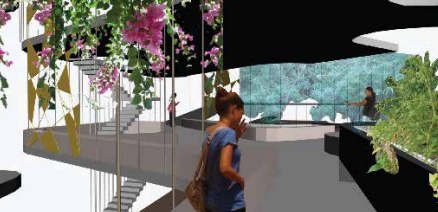
As I read it again, slowly, I saw where the sound of water was coming from. A huge waterfall flowed down gently from above. There were gardens up there and long creepers flowing down. It was a real Vertical Garden, catching the light of the sky. The sound of water created a very special atmosphere, a quietness and a listening, despite that there were many other visitors. It was all so intriguing, I wanted to know more and I needed to sit down somewhere for a bit.
That is when I notice two wings branching out of the Plaza area. One led to the Reception and a Welcome desk. There were restrooms further on and small cafés. As I walked up the Welcome desk, I saw large moving slides on a wall that offered quick information about the Gateway and images of the city of Auroville.
I picked up a few leaflets and a brochure from the Welcome desk and headed for a restroom stop. Now that was a refreshing surprise. Wonderfully clean, well looked after, it was set as though in an indoor garden. From there I walked over to a smart but very charming coffee shop run by an Auroville company and ordered a croissant and an excellent coffee. Even the furniture catches your eye, simple but elegant, it can actually be ordered. I noted down the contact details. Looking out of the windows, all I see is trees on every side and small gardens. It is very restful here but I want to know more about Auroville, why people choose to live here and build this city and about Matrimandir of which I have heard so much for years. But before rushing to go in, a friend advised me yesterday, try to know Auroville first.
I go back to the Information desk, and they point me to the main Auroville exhibition area on the other wing of the plaza from where one can also reach the Matrimandir Access desk.
The exhibition area was like entering a new universe. Two extraordinary spiritual beings, Sri Aurobindo and the Mother had founded the city. Named after Sri Aurobindo, Auroville is meant to be a first realization of human unity based on his teachings where people of all countries will be at home. Such a place exists! As I go through the exhibition I am amazed by the daring, the joy and experimentation this project has implied, but also the challenges and the depths it has encountered with that unique inner drive that seems to touch all things here. The city plan has four zones: Cultural, International, Residential and Industrial. One of its key spiraling features is achieved by curving lines that pass through green corridors and urban spaces. The Gateway is actually the far end of one such line, known as the Line of Goodwill. The exhibition has so much more: on organization, education, environment….I could stay here the whole day, there is so much history, so much real work, and so many funny anecdotes. As I leave the exhibition area my eye falls on a line: At last a place where one can think only of the future… And what an invitation that is, to explore new concepts, ideas and experiments that this place seems to asks from everyone, in all areas of life and work and play!
I had only planned for a day visit, but I need more time and I don’t want to leave without experiencing something of the Matrimandir. The Matrimandir Access desk is a quiet zone of information. To go inside I will need to make a booking so. A line of images greet me as I walk down a beautiful corridor to the Booking Office. Matrimandir is also known as the soul of Auroville. It was built from scratch, on an absolutely barren land, now golden and complete, surrounded by very special gardens and a lake that is now in process of being completed. It is inspiring to see how far determined people can reach in a relatively short time span. Human beings are very strong when they can work together in unity for a common higher goal.
It is past noon and I am lucky the Matrimandir Booking Office is open and I am even luckier when they say I can get a reservation to visit the Inner Chamber tomorrow at 9. Could I stay somewhere for the night? I return to the Welcome desk where I am informed about overnight budget dorms for students and groups or the rooms that the Matrimandir allots to people who have already a made prior booking but want to arrive a day early. Then there are simple Japanese Style sleeping cubicles and rooms and other more comfortable options. I opt for a Zen room on the 13th floor cluster called Forest View. I take the lift up to my room and sit down for a moment of wonder and enjoy how lucky I have been. My hotel room is very elegant but also very simple and minimal. Everything is white and serene I feel very calm and quiet here. The window overlooks a forest but I also get a sense of the curving Line of Goodwill that leads to the centre of town through the trees and, of the International Zone that borders the building. The pamphlet in the room indicates that there is a Sunset meditation in the highest of the gardens open for resident guests. I don’t want to miss that, but now I have all day to explore.
How does such a city function, I wonder? How does it sustain itself, what does its Industrial zone offer? I head back to the plaza, to the wing that leads off to the ground level, to an area where all the Auroville production units are represented. I was looking forward to this. I had heard so much about this conscious retail centre. Even shopping mall people come here to see what Auroville calls a conscious consumer experience. And it is very different! It is a huge area in two floors with many small green spaces in a two-floor height with light coming down from the big plaza above – and not a single shop! It all seems to be woven seamlessly together with no visible borderline between different areas. A very elegant bookshop, more like a private library, is woven together with a French café, people can look at magazines and read books, surf on internet while having a coffee or juice. There are books on Auroville and by Aurovilians and the place seems very popular with young people. I know most of the Auroville products, but here they are presented together like in a very large home. The many life style interior products, design and style products are also socially and environmentally aware. There are furniture, lighting, art and craft and music products, but none of these are displayed as in a shop but as in living areas. The area for all the Specialty Food products that Auroville makes is woven together with small cafés, and you can even taste some of these before buying. In a number of places you can see the chefs working behind glass walls, and follow the production process as in the bakery or, watch fascinating tofu recipes come to life with fresh organic salads and vegetables from Auroville farms or, get pizzas topped with your favourite Auroville cheese. I choose to lunch in a quaint Korean restaurant which invites you to eat mindfully. Some of the people working here have lived in Auroville for decades or have grown up here. Some are volunteers making their experience by living and working here.
All this leads to the next two floors where it is all about the research and experiment that has led to all kinds of truly interesting sustainable innovations in solar energy, windmill technologies, bio-dynamized water, now recognized for its healing properties, waste management, plus waste water management, sustainable building practices, afforestation and soil regeneration, organic farming and much more. Solar panels that line the roof of the Line of Goodwill are produced in the Industrial zone and supply a good chunk of energy to the Gateway as well. All this knowledge, the practices and the products can be transferred to other places and institutions as it is already being done in different places in India and around the world. My nephew needs to come here! But it doesn’t stop there. There are innovations in education and in organization seeking new, conscious models and there is art and music and literature in this city of Universal Culture. Some works of art are on par with Indian and international artists, yet unique. Some of the art is inbuilt in spaces in the Gateway, in the Line of Goodwill and elsewhere in Auroville, bringing an inward magic, a higher frequency of beauty in dialogue with all the rest. A sizable earning from all the retail products, industrial products, services and innovations and research in design contribute to the running and growth of the city and its greenbelt.
Higher up the building has different types of hotel options and a number of offices, also a health zone with a gym, quiet zones to relax and rejuvenate, plus other services. But, before getting that far, there is a whole floor with conference rooms and auditoriums and open plazas with many events, workshops and talks and some cafeterias. Because I am staying overnight I could access some of the talks and events, but to participate in workshops I would need to register beforehand and stay longer. I attended a session on the possibilities of Unending Education and one on Garbology, and education module created to deal with the humungous garbage problem in India and elsewhere. I know now that I am coming back with my daughter during her holidays.
On the fifth floor I came across a running ticker listing all the programmes, talks and events in different parts of the building and also programmes and places where one can volunteer should one want to spend more time in Auroville. As a place of Karma Yoga, one is encouraged to join in activities and work in order to participate in some way, be it in a farm, or in a school, a building project, or a Tai Chi workshop and not just hang around if one plans to stay longer, for it is such a vast place of learning and experience. The brochure lists guest spaces in the Line of Goodwill and other parts of Auroville if one wants to stay longer.
There is also the possibility of joining a guided tour of the International Zone, but I need time to absorb what I have already seen so far. It will have to wait for another day and I still have some shopping to do, for my family and friends, and for myself and a few books and brochures to pick up. An hour later, shopping done, I take the elevator up to my room, leave all the bags there and go to the 15th floor for the Sunset Meditation. On the high terrace I join a dozen people watching the sun go down. As we sit in meditation the sun spreads like a sunset masterpiece through the clouds and such a vast silence embraces us.
I return to my Zen room and order a light salad. All day I was in a sound space of so many languages, many Indian varieties plus Italian, French, Russian, Spanish, Japanese, Korean, African, Brazilian and so may English accents, all in harmony, together. I set the alarm clock and fall into a deep and peaceful sleep, the best sleep I have had for years. Tomorrow is a big day, and I must be ready for an encounter with the soul of this city…
At 7 am I get a delicious idli breakfast downstairs and exit the plaza from the back entrance. To reach the Matrimandir Access entrance one must walk through a forested green corridor that traverses a canyon. It is a short but amazing walk through the trees and permaculture gardens and the recycled waste water waterfall that services the gardens. The Matrimandir access group welcomes us, check our passes and directs us to a video room where one gets an introduction about what Matrimandir really is, not some golden temple or golf ball but place of concentration at the very centre of the city. A place of silence to find one’s soul…We board a monorail along a flank of the Line of Goodwill that takes us gently through the landscape to our point of exit at the Crown. From here, for the time being we are carted in electric vehicles to the Matrimandir gate. A lake is being built and will be ready in a year. From there we walk through the gardens, past the legendary banyan tree and up inside that golden sphere, where suddenly, the world seems to change from inside. We move up a spiraling ramp to a silent white chamber where a single ray of sun falls on a crystal. I can’t translate the experience in words yet, for it is at another frequency of silence. Suffice to say that it is something that will stay with me forever.
But it is time to get back home – family and work are waiting. I have only been away one day and one night, but it feels like much, much longer. I even don’t feel like the same person I was when I arrived. Life feels so much wider and richer. I have often felt a deep need for change in the way we live, but the daily routines do not leave much space. Now I feel I have been given tools and inputs to change.
UMA
The Mother on Auroville – a book published in 1977

This is a collection of messages, talks and answers from The Mother which relate to Auroville. It is not exhaustive but fairly complete.
Continue readingSri Aurobindo and the Earth’s Future
This article was written for All India radio, broadcast on 1st February 1972, on the occasion of Sri Aurobindo’s Birth centenary.

Sometimes a great wandering Thought sees the yet unaccomplished ages, seizes the force in its eternal flow and precipitates on earth the powerful vision which is like a power able to materialize that which it sees. The world is a vision coming into its truth. Its past and its present are perhaps not really the result of an obscure impulse which goes back to the depths of time, of a slow accumulation of sediments which little by little fashion us only to stifle and hem us in. It is the powerful golden attraction of the future which draws us in spite of ourselves, as the sun draws the lotus from the mud, and drives us to a glory greater than any of our mud or our efforts or our present triumphs could have foreseen or created.
Sri Aurobindo is this vision and this power of precipitating the future into the present. What he saw in an instant the ages and millions of men will unwittingly accomplish. They will unknowingly set out in quest of that new imperceptible quiver which has penetrated the earth’s atmosphere.
From age to age great beings come amongst us to hew a great opening of truth in the sepulcher of the past. And these beings are, in truth, the great destroyers of the past. They come with the sword of Knowledge and crumble our fragile empires.
This year, we are celebrating Sri Aurobindo’s Birth Centenary. He is known to barely a handful of men and yet his name will resound when the great men of today or yesterday are buried under their own debris. His work is discussed by philosophers, praised by poets. His sociological vision and his yoga are acclaimed. But Sri Aurobindo is a living ACTION, a Word made manifest which is even now being realised. And through the thousand circumstances which seem to rend the earth and smash its structures we daily witness the first reflux of the force which he has set in motion. At the beginning of this century, when India was still struggling against British domination, Sri Aurobindo declared: “It is not a revolt against the British Government…(which is needed), it is, in fact, a revolt against the whole universal Nature.” [Evening Talks, p.45].
For the problem is fundamental. It is not a question of bringing a new philosophy to the world nor of so-called illuminations. It is not a question of rendering the Prison of our lives more habitable, nor of endowing man with ever more fantastic powers. Armed with his microscopes and telescopes the human gnome remains none the less a gnome, wretched and powerless. We send rockets to the moon but we know nothing of our own hearts. “It is a question,” says Sri Aurobindo, “of creating a new physical nature which is to be the habitation of the Supramental being in a new evolution.” [On Himself, p. 172]. For, indeed, he says, “the imperfection of Man is not the last word of Nature, but his perfection too is not the last peak of the Spirit.” [The Life Divine, p. 680]. Beyond mental man, which is what we are, there opens the possibility of the emergence of another being who will be the spearhead of evolution as man was once the spearhead of evolution among the great apes. “If“, says Sri Aurobindo, “the animal is a living laboratory in which Nature has, it is said, worked out man, man himself may well be a thinking and living laboratory in whom and with whose conscious cooperation she wills to work out the superman, the god.” [The Life Divine, p. 5]. Sri Aurobindo has come to tell us how to create this other being, this supramental being, and not only to tell us but actually to create this other being.
He has come to open the path of the future, to hasten upon earth the rhythm of evolution, the new vibration which will replace the mental vibration – as a thought came one day and disturbed the slow routine of the beasts – and which will give us the power to shatter the walls of our human prison.
Indeed the prison is already crumbling. “The end of a stage of evolution,” announced Sri Aurobindo, “is usually marked by a powerful recrudescence of all that has to go out of the evolution.” [The Ideal of the Karmayogin, p. 42]. Everywhere about us we see this paroxysmal exploding of all the old forms: our frontiers, our churches, our laws. Our morals crumble on all sides. They do not crumble because we are bad, immoral, irreligious, nor because we are not sufficiently rational, scientific, human, but precisely because we have come to the end of being human! to the end of the old mechanism – because we are in a state of transition towards SOMETHING ELSE. It is not a moral crisis that the world is going through, it is an “evolutionary crisis”. We are not moving towards a better world, nor, for that matter, towards a worse one. We are right in the midst of MUTATING into a radically different world, as different as the world of man was different from the ape-world of the Tertiary Age. We are entering a new era, a supramental quinquennium. We leave our countries, become itinerants. We go in quest of drugs, in quest of adventure. We go on strike here, enact reforms there, start revolutions and counter-revolutions. But this is only an appearance; in fact this is not at all what we are doing. We are unwittingly in quest of the new being. We are in the midst of human revolution.
And Sri Aurobindo gives us the key. It may be that the meaning of our own revolution escapes us because we seek to prolong that which is already in existence, to refine it, improve it, sublimate it. But the ape, in the midst of his revolution which produced man, may have made the same mistake and perhaps sought to become merely a super-ape, a better climber of trees, a better hunter, a better runner, in short an ape with greater agility and increased capacity for malice. With Nietzsche we also wanted a “superman” who was nothing more than a colossalisation of man. The spiritually minded want a super-saint more richly endowed with virtue and wisdom. But we want nothing of human virtue and wisdom! Even when carried to their extremest heights these are no more than the old poverties gilded over, the obverse of our tenacious misery. “Supermanhood,” says Sri Aurobindo, “is not man climbed to his own natural zenith, not a superior degree of human greatness, knowledge, power, intelligence, will, … genius, …saintliness, love, purity or perfection.” [The Hour of God, p. 6].
It is SOMETHING ELSE, another vibration of being, another consciousness.
But if this new consciousness is not to be found on the peaks of the human, where are we to find it? Perhaps, quite simply, it is to be found in that which we have most neglected since we entered the mental cycle, it is to be found in the body. The body is our base, our evolutionary foundation, the old stock to which we must always return, and which painfully compels our attention by making us suffer, age and die. “In that imperfection“, Sri Aurobindo assures us, “is the urge towards a higher and more many-sided perfection. It contains the last finite which yet yearns to the Supreme Infinite. God is pent in the mire … but the very fact imposes a necessity to break through that prison.” [Sri Aurobindo came to me, p.414]. The old Ill is still there never cured; the root has never changed, the dark matrix of our misery is hardly different now from what it was in the time of Lemuria. It is this physical substance which must be changed, transformed, otherwise it will pull down, one after another, all the human and superhuman artifices which we try to impose on it. This body, this physical cellular substance shuts in “almighty powers” [Savitri, 4.3, p.420], a dumb consciousness which harbours all the lights and all the infinitudes just as well as all the mental and spiritual immensities. For, in truth, all is Divine and unless the Lord of all the universe resides in a single little cell he resides nowhere. It is this original, dark cellular prison which we must shatter, and as long as we have not shattered it, we will continue to turn in vain in our golden circles or our iron circles of our mental prison. “These laws of Nature,” says Sri Aurobindo, “that you call absolute … merely mean an equilibrium established by Nature … it is merely a groove in which Nature is accustomed to work in order to produce certain results. But if you change the consciousness, then the groove also is bound to change. ” [Evening talks, p. 92].
This is the new adventure to which Sri Aurobindo calls us, an adventure into man’s unknown. Whether we like it or not the whole earth is passing into a new groove, but why shouldn’t we like it? Why shouldn’t we collaborate in this great, unprecedented adventure? Why shouldn’t we collaborate in our own evolution instead of repeating the same old story a thousand times, instead of chasing hallucinatory heavens which will never quench our thirst or otherwordly paradises which leave the earth to rot along with our bodies?
“Why should life have begun at all if it is only to be climbed out of?” exclaims the Mother, She who continues Sri Aurobindo’s work. “What is the use of having struggled so much, suffered so much, of having created something which, in its outer appearance at least is so tragic, so dramatic, if it is only to learn how to climb out of it – it would have been better if it had not been started at all …Evolution is not a tortuous path which brings us back, somewhat battered, to the starting-point. It exists “, says the Mother, “quite on the contrary, in order to teach the whole of creation the joy of being, the beauty of being, the grandeur of being, the majesty of a sublime life and the perpetual development, perpetually progressive, of this joy, this beauty, this grandeur. Then everything has a meaning. ” [Talks/Questions and Answers 1958: 12.11.58]
This body, this obscure beast of burden which we inhabit, is the experimental field of Sri Aurobindo’s yoga of the whole earth. One can readily understand that if a single being amidst our millions of sufferings, manages to negotiate the evolutionary leap, the mutation of the next age, the face of the earth will be radically changed. Then all the so-called powers with which we glorify ourselves today will seem childish games before the radiance of this all-mighty spirit incarnated in the body. Sri Aurobindo tells us that it is possible, not only that it is possible but that it will be done. It is being done now and all depends not so much perhaps on a sublime effort of humanity to transcend its limitation – for it means still using our own human strength to free ourselves from human strength – as on a call, a conscious cry of the earth to this new being which the earth already carries within itself. All is there, already within our hearts, the supreme Source which is the supreme Power, but we must call it into our concrete forest. We must understand the meaning of man, the meaning of ourselves. The multi-voiced cry of the earth, of its millions of men who cannot bear the human condition any longer, who no longer accept their prison, must create a crack through which will surge in the new vibration. Then all the apparently ineluctable laws which close us into our hereditary and scientific groove will crumble before the Joy of the “sun-eyed children” [Savitri, 3.4, p. 389].
“Expect nothing of death,” says the Mother, “life is your salvation. It is in life that we must transform ourselves. It is on earth that we progress. It is on earth that we can accomplish. It is in the body that the Victory is won. ” [Talks/Questions and Answers 1957: 27.12.57]
And Sri Aurobindo says: “Nor let worldly prudence whisper too closely in thy ear; for it is the hour of the unexpected.” [The Hour of God, p. 4]
December 9, 1971
Satprem
[translated from the French by Maggi Lidchi, Pondicherry]
Born in Paris, Satpremcame to Pondicherry in 1953 after surviving the horrors of Hitler’sconcentration camps. He met the Mother and a life long quest began, of trackingHer evolutionary journey. The result of this collaboration resulted in thirteenvolumes of the Mother’s Agenda andbooks that have inspired so many like: SriAurobindo, or the Adventure of Consciousness, The Mind of the Cells, Onthe Way to Supermanhood and more.
The City the Earth Needs

Auroville Mission Statement
“Auroville wants to be a universal town where men and women of all countries are able to live in peace and progressive harmony above all creeds, all politics and all nationalities. The purpose of Auroville is to realise human unity.”
The Mother, Founder of Auroville
This was the first public message on Auroville sent into the world in 1965. Three years later, at the inauguration ceremony of Auroville on 28th February 1968, youth representing 121 nations and 23 Indian states placed a handful of earth in a lotus-shaped urn, symbolising the creation of a city dedicated to international understanding and planetary transformation.
Programmes
Envisaged as a city for 50,000 people, Auroville is an emerging township of presently about 2,500 volunteers from India and from some 50 countries around the world. Located in a rural area of Tamil Nadu, South India, it is surrounded by 13 villages with a population of approximately 40,000 people.
Over the past decades, Auroville has been dedicated to a wide range of development programmes, in many of which it has made impressive achievements. Programmes have been carried out in the following fields of activity:
- Art and Culture
- Educational Research
- Environmental Regeneration
- Handicrafts & Small-Scale Industries
- Health & Healing
- Innovative Building Technologies
- Integrated Urban Planning
- Organic Farming
- Renewable Energy
- Rural Development
Support Base
Auroville received the unanimous endorsement of the General Conference of UNESCO in 1966, 1968, 1970 and 1983. Governmental and non-governmental organisations in India and abroad have funded various development programmes. Donations have also been given by foundations in Europe and the United States, by Auroville International Centres and private donors from all over the world. The Auroville residents themselves have made a major contribution of financial resources and energy to the Auroville project.
Legal Status
In 1988, the Government of India passed the Auroville Foundation Act to safeguard the development of the International Township of Auroville according to its Charter. Under this Act, an autonomous institution, the Auroville Foundation, has been established with a Governing Board presently chaired by Mr Kireet Joshi and an International Advisory Council. In his presentation of the Act before Indian Parliament, Sri P. Shiv Shanker, the then Indian Minister of Human Resource Development, said:
“Auroville is to be looked upon as a vision which has a great potentiality and this can be of tremendous service to our country and the world at large.”
Arts & Culture
Over the past decade, Auroville has developed a multifarious cultural scene that is quite remarkable for a population of just over 2,000 people.
Many outstanding music performers, both from within India and abroad, perform regularly in Auroville. Eminent musicians such as Zakir Hussain, Shiv Kumar Sharma, Pandit Jasraj and Marcus Stockhausen have been giving concerts. Live performances by Auroville residents of western and eastern classical music, as well as of jazz and popular music, and blends of Indian and western music occur frequently. Music education is given for a variety of western and eastern instruments, such as vocals, violin, piano, flute, guitar, tabla and harmonium. Also, an adult’s and a children’s choir is regularly rehearsing and giving performances.
Resident theatre artists have created several theatre groups who perform in English or Tamil. A wide range of theatre classes, such as acting, improvisation and mime are being offered to adult Aurovilians and children alike. Teachers in the Auroville schools use original theatre, music and dance to explore body expression and induce concentration and imagination.
Auroville has been fortunate to host many visiting dancers of national and international repute, while the background of the dancers residing in Auroville is diverse. Predominant is the influence of western contemporary dance and of Bharat Natyam, the traditional dance form of the South Indian state of Tamil Nadu. Dance education follows naturally the intense dance activities and is part of the curriculum of the Auroville schools. Today classes are offered in improvisation, modern dance, Indian classical dance and African dance.
Besides local productions, international publishing companies such as Amity House, Banyans Books, Writers Workshop and Penguin have published poems from Auroville poets. One of Auroville’s Tamil poets has been officially laureated as one of the great modern poets of India.
Numerous artists resident in Auroville have studied in art institutions all over the world. They are exhibiting their works in Auroville as well as in India and in major galleries in Europe. The preferred media are oil, acrylic and watercolours, pastels, pencil and chalk. For sculpture and bas relief works a variety of materials such as terra-cotta, ceramics, plaster, wood, metal, marble and granite are being used.
Auroville is an affiliate member of RES ARTIS, an international network which promotes residential exchange programmes for artists world-wide to do research, work with other artists, and to strengthen international ties and understanding of the diverse cultural heritages that invigorate the human society.
Educational Research
Auroville’s Charter speaks about Auroville as “a place of unending education”, thus introducing the concept of a life-long process of development towards a person balanced in body, mind and spirit.
Auroville’s educational research endeavours to nurture the child’s potential to its highest possible level, and is based on a child-centred approach. A free choice system, allowing the student to increasingly choose his/her own subjects for study, is gradually being introduced, in particular in the more advanced courses. Also, sports and physical education are strongly emphasized for balanced and healthy growth of the children. Artistic training is an intrinsic part of Auroville’s system of education, which encourages the child to develop his/her artistic faculties and sense of beauty.
At present, there are crèches, kindergartens, primary schools and one high school in Auroville, next to 4 day-schools and over 15 part-time evening schools for the children of the nearby villages. About 1000 children from the neighbouring villages and from Auroville are benefiting from Auroville’s educational programme.
Research papers on Auroville’s educational work are regularly published and two major publications “The Aim of Life” and “The Good Teacher and the Good Pupil” have been produced to help invigorate a new, integral approach to education.
Education in Auroville is administered under the umbrella of the Sri Aurobindo International Institute for Educational Research (SAIIER), an organisation established in 1984 to focus on Auroville’s multi-faceted educational and cultural activities for both children and adults.
Environmental Regeneration
Auroville has gained national and international acclaim for its wasteland reclamation and reforestation work. More than 2,500 acres of near barren and visibly dying land have been transformed into a lush green area. Comprehensive contour bunding and the building of small check dams for soil and water conservation have significantly enhanced the life-support potential of the whole area. Over 2 million forest trees, hedge trees, fruit, and fuel wood trees have been planted.
The Auroville Centre for Ecological Land Use and Rural Development, “Palmyra”, has been carrying out soil and water conservation, and reforestation programmes over the last decade on almost 3,000 acres of village land with a total of more than 1.2 million trees having been planted. Palmyra also offers training programmes for farmers, NGOs, and government officers in the field of ecological and sustainable land use.
Handicrafts and Small-Scale Industries
There are more than 100 commercial units, both large and small, operated by Auroville at present. Their activities are diverse and include handicrafts (such as ready-made garments for adults and children, candle and incense products, embroidery, crochet, quilts, hand painted silk, beadwork, jewellery, postcards, leather work, pottery, paper lampshades, woodwork, etc.), printing and graphic design, food processing, electronics and engineering, computer software, windmill manufacturing, and construction and architectural services.
In terms of its own maintenance, Auroville wishes to become increasingly self-sufficient. Auroville’s commercial units have an important role to play in achieving this objective. Besides generating funds to assist the community in maintaining its basic services and infrastructure, the units provide employment and training for the local villagers, enabling them to improve their standard of living and acquire valuable skills. At present, about 5,000 villagers are employed in Auroville.
Health & Healing
Many systems of primary health care are in use in Auroville, including allopathy, homoeopathy, acupuncture, chiropody, podology, massage, chromato-therapy, and others.
The Auroville Health Centre, recognised as a Mini Health Centre by the Tamil Nadu State Government, is equipped with basic medical facilities and staffed by an international team. It serves the Auroville community as well as about 200 patients daily from the villages at its headquarters in Kuilapalayam and its sub-centres. A team of 30 local women trained as village health workers serve in 17 villages, giving first aid, home cures and basic health education. The Auroville Health Centre also runs a dental care unit, a children’s home for pediatric treatment, a medical lab, a pharmacy and a small medicinal plant garden, and offers several preventive health programmes to village women and children.
Under the aegis of The Indian Foundation for Revitalization of Local Health Traditions (FRLHT), Auroville hosts one of the 15 Medicinal Plants Conservation Parks which are being set up in the three South-Indian states of Kerala, Karnataka and Tamil Nadu. The aim of these centres is to revive the local health traditions and the ancient medical systems of India as described in the Ayurveda and its Tamil equivalent, the Siddha. For this purpose, Auroville has established an ethno-medicinal forest area to conserve medicinal plant diversity, an outreach nursery focusing on medicinal plant propagation and distribution, and a Bio-Resources Centre dedicated to education, training and research in the use of locally available medicinal plants in primary health care.
In 1997, a new healing centre complex, “Quiet”, near the beach was inaugurated to focus on providing alternative healing therapies. An international homoeopathic seminar, led by world-renowned homoeopaths from India and UK, marked the beginning of a new chapter in Auroville’s endeavour to combine new therapies with conventional health care.
Since July 2008 Kailash Clinic is operating, right in the middle of Auroville. It is a pilot project of the Integral health Services (IHS), based on an interdisciplinary approach to medicine.
It is providing doctor’s consultations, first aid and wound dressing in the morning and complementary therapies in the afternoons.
Innovative Building Technologies
Auroville has gained considerable knowledge and expertise in the field of innovative, appropriate and cost-effective building technologies, especially earth construction and ferro-cement.
Earth construction uses compressed earth blocks, made with a manual press from local earth mixed with 3-5% cement. The blocks are usually produced on the building site, without polluting the environment or depleting the forests, as no kiln firing is required.
Ferro-cement is a thin cement mortar laid over reinforcing wire mesh, thus employing steel and cement in a highly efficient and cost-effective manner. It is cheap, strong, versatile and long lasting, and the basic techniques are easily acquired, making this building technology readily accessible to the neighbouring villagers. Ferro-cement doors, roofing channels, water tanks, biogas systems, latrines and other building components are being manufactured in Auroville.
The Auroville Building Centre, which is part of a national network of more than 500 building centres all over India initiated by the Housing and Urban Development Corporation of India (HUDCO), provides regular training programmes for masons, master masons, site supervisors, contractors, engineers, and architects. It also offers consultancy, designs buildings and supervises construction sites using these appropriate, cost-effective building technologies. In 1995 and in 1996, the Auroville Building Centre received via HUDCO the yearly Outstanding Performance Award from the Ministry of Urban Development and Poverty Alleviation for its activities in this field.
Integrated Urban Planning
Auroville is located on a low-lying plateau on the south-eastern coast of India, 160 km. south of Madras. At the centre, both physically and spiritually, stands the nearly completed Matrimandir, “the soul of Auroville”. Started on 21st February 1971, construction work on this structure has continued uninterruptedly ever since. The inner chamber of Matrimandir, a place for silence and concentration, has been completed and, at present, the work focuses on finishing the outer structure and creating the surrounding gardens.
Four zones will radiate out from the Matrimandir gardens: International, Cultural, Residential and Industrial. The Green Belt, an area for promoting biodiversity, environmental restoration and organic farming, will eventually surround the entire city area. While much of the land still has to be purchased, Auroville presently manages about three-quarters of the total acreage within the future city area, and about 25% within the Green Belt.
The present community of Auroville consists of some 100 settlements of varying sizes. Auroville has created a basic infrastructure of roads, water and electricity supply, and telecommunications, including an electronic communications network. Accommodation has been constructed for 1,500 people, and municipal services for food production, purchase and distribution, electricity and water supply, waste disposal and recycling, education, health care, financial transactions, and town planning have been established.
The Auroville Township Master Plan 2000 – 2025, which has been recently endorsed by the Government of India, is dedicated to the challenge of creating an environment-friendly, sustainable urban settlement that, at the same time, integrates and cares for the neighbouring rural area.
Auroville’s concept is therefore to build a city that will economise on land needs by introducing development approaches with an optimum mix of densities and appealing urban forms and amenities, while the surrounding Green Belt will be a fertile zone for applied research in the sectors of food production, forestry, soil conservation, water management, waste management and other areas which assist sustainable development. The results of such innovative methods would be available for application in both rural and urban areas in India and the world.
Organic Farming
The development of an ecologically sound agriculture, which excludes the use of pesticides and detrimental chemicals, and the application of agro-forestry techniques are being actively pursued in Auroville. Efforts are being made with the surrounding village farmers to reverse the process of growing cash crops using chemical inputs in the form of fertilisers and poisonous pesticides such as DDT. Alternative biodegradable pesticides are being developed and marketed as part of an overall attempt to re-introduce sustainable agricultural practices throughout the bioregion.
Training programmes are regularly organised for farmers from the surrounding area. On the national level, Auroville has participated in many Indian conferences on organic farming, and hosted in April 1995 an All-India seminar on organic farming under the name “ARISE: Agricultural Renewal in India for a Sustainable Environment”.
Renewable Energy
Concerned with the ecological implications of energy consumption, Aurovilians have been experimenting with the use of renewable energy sources from the beginning. The major forms of renewable energy utilised in Auroville are solar, wind and biomass. At present, more than 1,200 photovoltaic (PV) panels are in use for electricity and water supply. Some 30 windmills of various designs are in operation for pumping water, and specially designed ferro-cement biogas systems process animal and vegetable waste to produce methane gas and organic fertilisers. Today, Auroville has become a major testing ground for renewable energy sources in India.
The Auroville Centre for Scientific Research (CSR), a research institution approved by the Government of India in 1984, is the focal point for many of these activities. It also runs “Awareness Workshops towards a Sustainable Future” for NGO’s, government officials, students and professionals on the sustainable techniques applied in Auroville.
Rural Development
Rural development has been a major activity of Auroville since its inception. There are 13 villages in the immediate neighbourhood, comprising about 40,000 people, and altogether 40 villages in the bioregional area. At present, ten Auroville working groups have dedicated themselves to fostering sustainable programmes in these 40 villages.
With funding from a number of national and international organisations, Auroville’s rural development programme aims at:
- raising the standard of living of the local population through vocational training and self-employment;
- involving the villagers in a cooperative effort of wasteland reclamation and organic farming;
- improving the health situation through education, preventive care and treatment;
- empowering women and providing education to the village children;
- encouraging in each village the growth of community spirit and a sense of self-confidence through social initiatives, micro-projects and awareness campaigns.