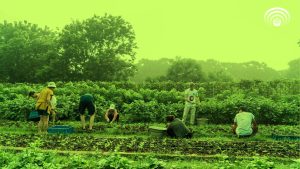
Earth and water are not backdrops to civilization; they are the body of civilization.
Earth and water are the first instruments of transformation. Without living soil and sustained water systems, the evolutionary city remains an idea without a body. In Auroville, ecology was never optional; it was the necessary base for manifesting a future civilisation. What began as survival work on eroded land became a decades-long research process testing how consciousness, when applied through collective labour, reshapes material reality.
Regenerating earth and water here was not environmentalism in the conventional sense. It was karma yoga in action: surrendered work, sustained aspiration, and the courage to act without guarantees. The land itself became the teacher.
“The future of humanity cannot be built on dead land.”
This is not just a romantic statement. It reflects the deep realisation that only living ground, alive with soil structure and active water cycles, can support a civilisation that aspires toward unity, sustainability, and collective transformation.
Framing the Spiritual Necessity
In the vision of Sri Aurobindo and The Mother, nature is not inert matter; it is a living force participating in evolution. Transformation of consciousness cannot bypass transformation of material conditions. For the experiment of Auroville, ecological regeneration was never an ethical preference but an evolutionary necessity. The environmental work undertaken here forms the invisible infrastructure of consciousness upon which every social, cultural, and economic experiment depends.
Ecology in Auroville is not a compartment of activism or a lifestyle brand. It is the foundation of practice. Engagement with earth and water here constitutes ongoing spiritual and material research, one that tests whether human aspiration can match the resilience and intelligence of the earth itself.
Much of this philosophical grounding has been articulated across Auroville’s own writing, including Auroville’s Sustainable Approach to Earth and Water Conservation on AwareAuroville.com, which highlights how afforestation, permaculture, and responsible water management form the backbone of ecological renewal here.
The Living Laboratory: Auroville’s Earth & Water Landscape
Auroville’s terrain is a laboratory of long-duration ecological research. Before the township was founded in 1968, the plateau was a barren, eroded landscape stripped of vegetation and topsoil. Annual monsoon rains carved deep gullies, and rainwater washed nutrients out to sea instead of feeding soil or aquifers. This situation mirrored the wider Kaliveli watershed region, where traditional interconnected “erys” (tanks) once stored rain for agriculture, but had largely fallen into disuse by the mid-20th century.
It was this context of loss that became the crucible for land and water renewal. Early efforts did not start with abundant knowledge; they started with commitment.
When the first residents began ecological work, soil regeneration began with patient, iterative intervention. Contour trenches were cut along slopes to hold rainwater; vegetative cover was planted to shield the soil; native and nitrogen-fixing species were introduced to begin rebuilding fertility. Soil was treated not as a commodity, but as living capital, essential to the community’s long-term future.
The principle was simple and exacting: slow water down, let the land breathe. Each trench, bund, and tree became a field experiment. With every rainy season, data formed not in laboratories but in the soil’s responses: how much water was absorbed, how quickly microfauna returned, which plant combinations improved cover and nutrient cycling. This embodied research process did not rely on outside theory but emerged from decades of contact with the land itself.
Collective Ecology: Shared Action and Learning
Ecology here became shared responsibility, not delegated labour. This collective work is evident in Auroville’s Green Belt, a multi-purpose ecological buffer that surrounds the township. The Green Belt was designed to promote biodiversity enhancement, environmental management, land regeneration, and water management for the township and surrounding villages.
The Green Belt encompasses farming zones, dense forest plantations, and experimental farms such as Siddhartha, Solitude, Annapurna, and AuroOrchard, among others. These farms are part of an ongoing experiment in soil regeneration, organic agriculture, and agroforestry that reflects long-term ecological thinking: no single season defines success, and no crop is considered in isolation from soil health and water cycles.
This integration of research, regeneration, and community labour makes the Green Belt both a protective ecological buffer and a teaching ground for sustainable practice.
Restoring Water: Water as Life’s Matrix
Water regeneration has been a central pillar of Auroville’s ecology work. Rainwater harvesting systems, including swales and percolation ponds, were designed according to landform and flow patterns. Rain was no longer treated as something to endure but as an ally to nourish the earth.
Recharge structures built over decades gradually pushed water below ground, allowing aquifer levels to rise. Infrastructure like check dams and contour bunds halted the torrential rush of stormwater into the sea, instead letting it soak deep into the soil. Wells that once ran dry during most of the year began yielding water once again. Springs and seasonal streams returned, and water security became measurable progress.
The Auroville Water Group continues this work, integrating participatory planning, sustainable water strategies, and community awareness to move toward a water-sensitive city that balances ecological need with human use.
Research & Regeneration: Connecting Practice to Inquiry
While Auroville’s ecology work is rooted in practice, there is a growing connection to formal research infrastructure. SAIIER’s research platforms support inquiry that emerges from lived experience, including soil, water, and food systems. This shift from practice into research infrastructure mirrors the township’s larger aim: not to import knowledge but to generate knowledge from within the lived context of ecological regeneration.
One example of this embodied research is visible at AuroOrchard, where systematic tracking of production data since 2022 has shown how biodiverse agroforestry practices correlate with soil moisture retention and seasonal yields. Early findings indicate that carefully designed plant diversity and timing irrigation to soil moisture conditions can reduce irrigation needs significantly while increasing seedling survival. These insights, grounded in field data, are reshaping approaches to soil life and water dynamics in regenerative agriculture.
Institutional Stewardship & Conscious Infrastructure
The Auroville Environment Trust (TDEF) provides longevity and continuity to ecological stewardship, ensuring interventions evolve with feedback from the land rather than remain rigid. This long-term commitment transforms ecology from a project into a discipline of living.
Ecology also reshapes how work itself is organised here. Time is offered as service; labour is participation in evolution; and commitment is measured in decades rather than financial quarters. Earth care becomes embedded in collective life, forming a material infrastructure of consciousness that materialises inner aspiration.
This ethos is expressed across Auroville’s documented environmental initiatives captured in writings like Guardians of Earth and Water: Auroville’s Environmental Initiatives which describes afforestation, organic farming, biodiversity protection, permaculture, and water stewardship as community pillars, not optional add-ons.
Indicators of Regeneration: What Has Changed
The transformation of the landscape is both visible and measurable. Tree plantations, once sparse, now form belts of green across dunes and plains. Soil structure has improved through continuous vegetative cover, microbial life, and nutrient cycling. Water percolation now stabilises rather than erodes.
Bird species that were once rare in the region, fewer than ten species recorded in the 1970s, now number more than a hundred is a sign that habitat and water availability have improved dramatically. Wildlife such as jackals, porcupines, and civet cats have re-established presence as vegetative complexity increases.
Initiatives like Sadhana Forest exemplify this transformation on a specific site: volunteers and community members have worked for years to convert over 70 acres of barren land into a thriving forest ecosystem rooted in reforestation and water conservation. The site’s rainwater harvesting systems alone can store over 50,000 cubic meters of rainwater, and local water tables rose significantly within the first five years of intervention.
Ongoing Frictions and Active Inquiry
Despite these gains, the work is not complete. Ongoing land-use pressures, the need to scale regeneration beyond protected zones, and emerging climate challenges keep the field open. Expansion must never be at the expense of ecological limits. Monitoring soil health, water dynamics, and biodiversity becomes part of every planning decision.
This ongoing inquiry reinforces Auroville’s central insight: ecology is not a finished product but an active frontier of research and collective practice.
The Widening: Auroville & the Planetary Crisis
Globally, fertile soil is disappearing at an alarming rate; desertification expands; freshwater reserves are drawn down faster than they recharge. These patterns reflect not just a technical crisis but a civilisational disconnect between how societies treat land and how life thrives.
Auroville’s work stands in contrast. It shows restoration over exploitation. Earth and water are treated as living partners, not consumable inputs. Collective service, aspiration, and adaptive action produced results that policy alone could not achieve. This mindset, rooted in long-duration engagement and grounded inquiry, is transferable not as a fixed blueprint but as a way of relating to land and water.
The Synthesis: Toward 2068, The City the Earth Needs
Earth and water are not background conditions; they are future infrastructure. Material reality is not separate from consciousness. The land holds memory. Regenerated landscapes do not just sustain ecosystems but they stabilise human relations and socio-ecological resilience.
Over the next fifty years, soil and water regeneration must extend deep into the bioregion. Ecological data must inform every planning decision. Settlements must learn to generate water rather than drain it.
The future city begins beneath the feet. When aspiration stayed steady, help arrived from many quarters. Not as miracles, but as responses to collective intention and sustained effort.
Civilisation will not rise from concrete and pipelines, but from living earth and living water. Auroville’s experiment, rooted in soil and sustained by water, offers a living archive of what is possible and necessary for a world that seeks to endure.