When Relationship Comes Before Transaction
The unease beneath modern exchange
There is a certain stiffness in how we trade with one another now.
Every interaction seems wrapped in conditions. Terms are clarified earlyExpectations are documented. Safeguards pile up quietly, like sandbags against an unseen flood. It is not that people have become cruel. It is that trust has become expensive.
In workplaces, friendships, and even small community exchanges, there is a subtle bracing. We prepare to be disappointed. We protect ourselves in advance. Agreements arrive thick with clauses, timelines, penalties. Everything is accounted for except the human nervous system trying to stay relaxed inside it all. This is the ache many feel but rarely articulate. Not greed or dishonesty but a constant low-level vigilance and an economy of crossed fingers.
When trust erodes, systems compensate with weight. More paperwork. More oversight. More rules. Exchange still happens, but it feels heavy. Something alive has gone missing. Across the world, this unease is growing. Quietly, people are asking whether another way of exchanging might still be possible, one that begins somewhere other than suspicion.
An experiment where trust touches the ground
Along India’s southeastern coastline, where red earth stains the feet and the sea air softens the evenings, Auroville has been testing that question for over fifty years. Auroville was never meant to replicate existing economies with better ethics. It was meant to explore what human life might look like when money was no longer the central motive force. In practice, this meant something much messier than idealism.
Here, many exchanges begin with relationship first and agreement later. Sometimes there is no contract at all, only a shared understanding shaped through conversation, work, and time. Sometimes money changes hands long after the work has already begun. Sometimes not at all. This does not always feel comfortable.
Trust in Auroville is not abstract. It lives in awkward conversations, delayed payments, misunderstandings, and the uneasy moment when one person realizes they trusted more than the other was ready to hold. And yet, people continue. Not because it always works, but because something in them insists that trust must be practiced somewhere, or it will disappear everywhere.
Trust as vulnerability, not virtue
Outside Auroville, trust is often spoken of as a moral quality. Inside the experiment, it is experienced more as a risk. To trust is to expose oneself to loss of time, energy, resources and dignity. A trust-based exchange has fewer protections. When it breaks, it hurts more. This is where many idealistic economies quietly fail. They imagine trust as a stable condition, rather than a fragile relationship that requires constant attention.
In Auroville, trust does not float above human nature. It collides with it. People forget commitments and projects may run over budget. Expectations are assumed rather than clarified while old resentments leak into new collaborations. Trust frays not because people are malicious, but because they are human. What keeps the experiment alive is not purity, but willingness to stay in the discomfort long enough to learn.
A transitional economy for a transitional being
Sri Aurobindo wrote that humanity stands between what it has been and what it could become. Our economies reflect this in-between state clearly. We no longer believe that pure self-interest creates harmony. Yet we do not fully trust one another either. So we build systems that hedge. We speak of values while designing structures based on fear.
Trust-before-transaction exposes this tension sharply. It asks more of the individual than most economies do. It requires inner coherence, patience, and a capacity to tolerate uncertainty. Auroville tests whether such capacities can be grown collectively, rather than assumed. The results are uneven. Some thrive in this space. Others struggle deeply. Many oscillate between openness and withdrawal. This instability is not a flaw of the experiment. It is the experiment.
The slow labor of economic relationship
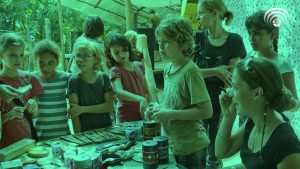
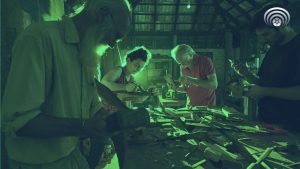
On an ordinary afternoon in Auroville, economy does not look dramatic. Someone repairs a pump knowing payment may come later. Someone cooks for a community kitchen without counting hours. Someone lends tools without tracking return dates.
None of this is heroic. It is slow. It requires memory, attention, and repeated recalibration.
Sometimes it fails. Tools may disappear, contributions can go unacknowledged while resentment builds quietly. When trust breaks, there is no legal department to absorb the shock. The shock lands directly in relationship. This is the price of lightness. When systems are light, humans carry more weight.
Auroville does not romanticize this. Many residents eventually ask for clearer structures. Agreements evolve and some safeguards appear. Trust here is not naïve but often negotiated, re-negotiated, and sometimes withdrawn.
The economy breathes in and out, tightening and loosening as needed.
When trust becomes tiring
One of the lesser-discussed aspects of trust-based exchange is fatigue. To trust consciously requires presence. One must stay attentive to signals, boundaries, and changes. In a world already saturated with decisions, trust can feel like another demand.
In Auroville, some eventually step back from trust-heavy exchanges, not because they no longer believe in them, but because they are tired of ambiguity, emotional labor and of holding space for unfinishedness. This inarguably is part of the learning.
Trust cannot be mandated. It cannot be endlessly extracted. It must be renewable, or it collapses under its own idealism.
What breaks, and what remains
Auroville’s economy has seen failures. Projects dissolve, funds run dry and relationships strain beyond repair. Some leave with bitterness. Others leave quietly and yet, something persists.
A shared understanding that exchange is not only about value, but about consciousness. That how we trade shapes who we become and an economy built entirely on suspicion trains suspicion into the nervous system. This understanding does not make trust easy but makes it necessary.
The World Economic Forum speaks of rethinking economic systems in response to global instability. From Auroville’s ground-level view, this rethinking is less about innovation and more about courage. The courage to risk being disappointed without closing entirely.
The unfinished question
Trust-before-transaction does not promise stability. It promises exposure.
Auroville has not solved the problem of economic trust. It has simply refused to abandon the question. It continues to test whether humans can grow into the responsibility that trust demands.
Some days the answer feels close. Other days painfully far. But perhaps the question itself is the point.
What the individual must carry
An economy grounded in trust does not begin with policy. It should begin inside the individual nervous system with the ability to stay present when outcomes are uncertain, with the humility to repair when trust breaks and the strength to say no when trust is misused. This is not a soft economy but a demanding one.
In a world rushing towards automated transactions and algorithmic certainty, trust asks us to remain human slow, fallible, and exposed.
Whether we are ready or not may determine what kind of economy can exist next. Neither perfect nor safe, but alive.