On freedom, unfinished institutions, and why learning here never quite settles into a system
Auroville has never promised answers: not in governance or economy, and certainly not in education. Those who grow up here often receive something rare: time, attention, space to listen inwardly, and an education not rushed by fear. Yet when they reach the edge of adolescence and when the world begins asking for degrees, certificates and proof, the questions sharpen.
Is there a university here? If not, should there be one? And what does it cost, inwardly, to live without that certainty? These questions do not come from critics alone. They arise from within the community itself, voiced by parents, educators, and youth who have lived inside this experiment long enough to feel both its generosity and its gaps.
Auroville was never meant to be a finished city. Its education system reflects that choice.
Learning as Growth, Not Preparation
Education in Auroville does not begin with the idea of preparing a child for the world. It begins with the idea of growing as a human being.
The Mother spoke of education not as schooling but as a lifelong process involving the body, the vital nature, the mind, and what she called the psychic being, the deepest truth within.
“The object of education is to give the child the means whereby he can develop his faculties and grow into a complete and harmonious being.”
— The Mother
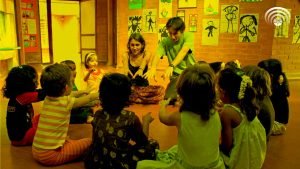
This approach shapes daily life in Auroville schools. Children are not rushed into competition and learning is often self-directed. Art, movement, farming, theatre, mathematics, silence are all treated as legitimate ways of knowing. In some schools, children choose what they want to engage with each day.
A cyclone passes through, and lessons shift. Repairing damage becomes the curriculum. Stories are written and observations are shared. Knowledge emerges from lived reality. For many educators, this feels closer to truth than any textbook. But truth that is lived slowly has consequences.
The Moment of Friction: After Class 12
As children grow older, the world outside Auroville begins knocking louder. Universities ask for marks while Institutions ask for boards and careers ask for credentials.
Auroville does not yet have a certified higher education system of its own. This is not an oversight. It is a tension the community has long been aware of, and struggled with. Young people often describe the same feeling: a deeply nourishing schooling experience followed by a sudden sense of being unanchored. Some leave Auroville to study elsewhere while others return. Educators acknowledge this gap openly and often there is no polished explanation.
Education is only a work in progress. The difficulty lies not in a lack of intelligence or capacity, but in translating a non-standard education into a world that still runs on standard measures.
Attempts, Not Institutions
There have been efforts to bridge this space. Internships in architecture, sustainable construction, ecology, agriculture. Learning spaces that draw students from across India and beyond. Informal programs that offer depth without certification.
Architecture, in particular, has emerged as a strong point. Students arrive to learn from Auroville’s decades of experimentation with earth construction, bioclimatic design, and community planning. Yet the question keeps returning: Can these become something more structured without becoming rigid? Can higher education exist here without betraying the spirit that shaped the schools? No one claims to have the answer yet.
A living network of schools, outreach centres, and lifelong learning spaces
In practice, Auroville’s approach to learning is not confined to a single school or method, but expressed through a diverse constellation of educational initiatives and institutions that serve children, youth, adults, and the broader bioregion. Within the township itself there are multiple schools inspired by the vision of Sri Aurobindo and the Mother, each with a distinctive approach to integral education. For younger children there are kindergartens such as Nandanam and Auroville Pre-Crèche that focus on nurturing attention, physical expression, and early sensory exploration; primary and middle school options include Transition School, designed for ages six to fourteen with a curriculum based on self-discovery and inner growth, and Deepanam School; secondary pathways include Future School and Last School, which support learners up to the nineteenth year and emphasise free progress and personalised learning approaches. Alongside these are Outreach Schools that bridge Auroville with the surrounding villages, such as Aikiyam School and Arulvazi Education Centre, which provide bilingual and culturally rooted education, and Udavi and New Era Secondary School (NESS), which work with broader academic and village community needs. Centres such as the Teachers’ Center foster professional development and networking for educators engaging with integral education, while specialised learning spaces like the Life Education Centre and vocational training initiatives work with young women, learners with varied needs, and skill-building beyond traditional classrooms. There are also programmes extending into After School opportunities for post-secondary exploration, apprenticeships, and practical engagement, reflecting the idea that learning continues beyond formal schooling. Across all these initiatives, the aim remains consistent: to support lifelong learning, practical experience, and the integral development of the whole being rather than merely preparing for exams or fitting into existing educational molds
Education as a City-Wide Experiment
What makes Auroville different is that education is not isolated within classrooms. It is embedded in the life of the city. Children grow up watching adults work without salaries, build homes they do not own, serve institutions without personal reward. They see governance debated, not enforced. They witness conflict, fatigue, sincerity, and failure.
Learning happens everywhere, and that is both its strength and its instability.
“All life is education.”
— Sri Aurobindo
Yet life does not issue certificates. This is where the experiment strains.
Teachers Without Titles
Many educators in Auroville resist fixed roles. They do not define themselves as “math teachers” or “science teachers.” They respond instead to what a child needs at a given moment. One day it is numbers, another day it is silence and the next day perhaps grief. This flexibility allows something rare: education that adapts to the child, not the other way around.
But it also depends heavily on inner discipline, on the teacher’s sincerity, on the student’s readiness, and on trust that learning will still happen without pressure. That trust is not always easy to hold.
Freedom and Its Cost
Freedom is often romanticized. In Auroville, it is experienced more plainly. Freedom requires maturity, exposes confusion and does not protect you from doubt.
Young people raised without fear-based motivation sometimes struggle when confronted with competitive systems elsewhere. They must learn new languagesof grades, deadlines, rankings, often quickly.
Some adapt, some resist and some may return with sharper clarity about what they want. Others feel the loss more deeply. And there is no single outcome.
Why a University Is Still Missing
Auroville does not have a University of its own because certification demands alignment with external authorities, structure risks hardening into habit and the community itself has not agreed on what such an institution should be.
The Mother warned repeatedly against premature form.
“To organize prematurely is to crystallize what should remain fluid.”
Hence, education here has been allowed to remain fluid perhaps longer than is comfortable. The result is both openness and uncertainty.
The Role of Faith
To live or study in Auroville requires a certain leap of faith. Not blind belief, but willingness to enter something unfinished. Many who arrive do not know how long they will stay. Some come for three months or decades. Some may leave and return.
Even long-term residents describe the feeling of having ‘just arrived’, years later. Education here is not something you complete. It is something that keeps undoing you.
Not a Model to Copy
Auroville does not present its education system as a model to replicate wholesale. Educators often say: take what works, leave the rest.
Teachers from around the world visit, observe, participate, and carry pieces back of reforestation methods, body-based learning, awareness practices and collaborative governance experiments. What cannot be exported easily is the context: a city attempting to live by free will rather than enforcement.
A Question That Remains Open
Is Auroville’s education enough to face the world, to survive economically or to justify its risks.
No one answers cleanly. What is clear is that the intention remains alive: to educate not for success, but for consciousness. Whether that will one day take the form of a university or remain deliberately unfinished, is still unknown.
Perhaps the more honest question is not whether Auroville should provide certainty. But whether we, as a society, are ready for an education that refuses to promise it.
Ending (Unfinished)
Auroville does not ask children to become successful.
It asks them to become sincere. What happens after that inside or outside its borders remains part of the experiment.