Why Integral Education refuses shortcuts, and what it asks of children, parents, and the future
The One Burning Question
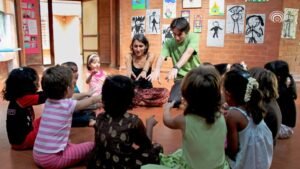
It usually comes after a pause. After walking through learning spaces where there are no bells, ranking charts, or anxious rush between classes. After watching children move between gardens, art rooms, workshops, libraries, and open ground with an ease that feels unfamiliar.
Then the question arrives, often lowered in volume, as if spoken to oneself as much as to the guide. But will they be okay later?
What is being asked is not unkind but rather protective, parental, and human. Anyone who visits Auroville may wonder how children compete later, how they face exams, discipline, careers and expectations. Beneath all of it sits a deeper concern: whether a child can grow without pressure and still survive a world built on comparison.
Auroville does not rush to reassure. Because reassurance is not the purpose of education but growth.
Education as Awakening, Not Training
Integral Education in Auroville begins from a radical premise articulated by Sri Aurobindo and insisted upon by the Mother: education is not meant to fill the mind, but to help the soul emerge.
“The true aim of education is to help the growing soul to draw out what is best in it.”
— Sri Aurobindo
This is not treated as a poetic sentiment. It is a practical orientation that shapes daily choices. Learning here addresses the physical being through movement and care of the body; the vital being through emotional awareness and regulation; the mental being through clarity, curiosity, and understanding; and the psychic being through sincerity and inner truth.
Conventional systems focus almost entirely on the mental surface, often driven by performance and memory. Integral Education insists that an anxious emotional life or an unformed vital can undermine even the sharpest intellect. So the work begins deeper, slower, and often invisibly.
Freedom With Responsibility, Not Absence of Form
One of the most persistent misunderstandings is that Auroville schools are unstructured. In reality, they are structured differently. What is absent is coercion.
There are rhythms to the day, expectations of participation, responsibilities toward materials, spaces, and others. What is removed is fear; fear of failure, fear of punishment, fear of being less than someone else. Children are not ranked or publicly compared. Learning is not driven by anxiety about outcomes.
Educational research on intrinsic motivation, examining non-competitive and alternative learning environments, repeatedly points to the same conclusion: when motivation is internal rather than imposed, engagement becomes deeper and more durable. Auroville does not advertise this alignment with research. It simply lives the consequence.
The Cost of Freedom
Freedom in education is not inexpensive. It does not offer a ready-made path.
Children educated in Auroville do not move along a predictable ladder from school to university to career. Families must remain actively involved, making conscious choices about certification, timing, and transitions into external systems when needed. This creates uncertainty, particularly for parents shaped by competitive schooling themselves.
One parent once described it plainly during a community discussion: living here means you cannot outsource responsibility to a system. You carry it yourself. That is not always comfortable. It is, however, deliberate.
Integral Education does not replace parental consciousness but inevitably demands it.
Teachers as Companions in Growth
There are no gurus in Auroville schools. Teachers are not positioned as unquestionable authorities. They are guides, observers, and participants in a shared process of learning.
This alters the entire power dynamic. Teaching here requires attentiveness rather than control, responsiveness rather than standardisation. There is nowhere to hide behind rigid syllabi or external examinations.
Discipline Without Fear
Visitors often ask how discipline works without punishment. The question itself reveals how deeply fear has been normalised as an educational tool.
In Auroville, discipline is relational rather than punitive. Children are guided to recognise the impact of their actions, to understand consequence, and to develop self-regulation. This takes time. It also reaches places punishment never does.
The Mother was unequivocal on this point:
“Fear is the worst instrument of education.”
The aim is not obedience, but inner order.
Meeting the Outside World
Eventually, many Auroville-educated children step beyond the community. They enter universities, workplaces, cities, and systems structured by speed, hierarchy, and comparison.
The transition is not always smooth. Some experience initial friction with authority or evaluation. Others discover an unexpected strength: self-direction, adaptability, and clarity about their own interests. Auroville does not promise ease. It prepares for depth.
Education as a Collective Mirror
Education in Auroville is not a service delivered to families. It is a mirror held up to the collective.
It reflects the consciousness of parents, the sincerity of educators, and the coherence or fragmentation of the wider community. When education struggles here, it is rarely because of lack of method. More often, it reveals divided attention, unresolved fear, or conflicting values among adults.
Children grow according to the truth they sense, not the ideals they are told. This makes education here demanding, not for children first, but for those responsible for holding the environment.
Not a Model to Replicate
Auroville does not present its education system as a template to be copied. It cannot be exported intact. It depends too deeply on context, shared values, and voluntary participation. Scholars such as Lucy Sargisson, writing on utopian practice and education, caution against treating such experiments as blueprints. Their value lies not in replication, but in revealing what becomes possible when certain assumptions are removed. And Auroville agrees.
This approach works only when parents choose it consciously, when children are met as individuals, and when uncertainty is accepted as part of growth.
Education as Ongoing Yoga
When visitors ask about education in Auroville, they are often asking something quieter. Whether growth can be trusted without control, uncertainty can be tolerated without guarantees or who a child becomes can matter more than what they achieve.
Auroville does not answer these questions. It places people inside them. Education here is not preparation for life. It is life, lived attentively.
Sri Aurobindo warned that a new consciousness would not emerge through systems alone, but through patient inner work expressed in daily action. Education in Auroville is work that is unfinished, imperfect, and demanding.
There are no promises but only responsibility.