When Stepping Back Is Not Disappearing
The silence people don’t know how to read
There is a new kind of absence moving through social life. It does not look like rebellion. It does not announce itself loudly. It appears as fewer messages sent, fewer opinions shared and fewer rooms entered.
People are still present, but less available.
In conversations, there are longer pauses. In communities, familiar voices fade into the background. Online, many stop responding altogether. This withdrawal is often misread. It is labeled apathy, burnout, disengagement, or even indifference. But beneath it, something else may be happening. The world has grown dense with stimulation. Words arrive constantly, positions must be taken quickly and reactions are expected immediately. To stay fully engaged now requires a nervous system that can tolerate continuous demand. Many cannot and so they step back.
Quiet withdrawal is not always a rejection of society. Sometimes it is the only way left to breathe.
A place where stepping back is visible, not hidden
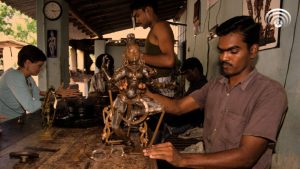
Along India’s southeastern coast, Auroville has been living with this phenomenon long before it became widely named. Here, withdrawal does not usually arrive dramatically. It shows up gently. Someone stops attending meetings for a while. Someone speaks less in discussions they once led. Someone chooses manual work over conversation. Someone spends more time alone.
This is not immediately questioned. It is noticed, but not forced open.
In Auroville, stepping back is not assumed to mean disengagement. It is often understood as an inward turn, a period of digestion after too much input. This does not mean it is always easy. Absence creates gaps, work must still be done and decisions still need voices. Withdrawal can strain collectives that already run on limited energy.
And yet, there is a general tolerance for it here. A recognition that participation cannot be constant without cost.
Overload as a social condition
Globally, the OECD speaks of social wellbeing and belonging as central to healthy societies. Yet belonging today often comes with relentless exposure. To belong is to be reachable, to be seen is to respond and to care is to engage endlessly. This creates a paradox. The more connected we become, the more many feel the need to disappear.
Quiet withdrawal may be less about disinterest and more about saturation of too many conversations without integration, too many conflicts without rest, and too many expectations layered onto already stretched lives. In Auroville, this is felt acutely because community life is close. There is little anonymity. Withdrawal is visible and cannot hide behind algorithms or distance.
This visibility forces a question that larger societies often avoid: how much engagement can a human nervous system actually sustain?
The difference between leaving and listening
Not all withdrawal is the same. Some people withdraw because they are done, finished or hurt beyond repair. Others withdraw because they are listening to something that cannot be heard amid noise. In Auroville, the second kind is common. Silence here is not always emptiness but can often be active, attentive and alive.
People speak of needing time to realign to return to ground, and to feel what is true before speaking again. This is not framed as self-care in the popular sense. It is framed as responsibility.
To speak without clarity is to add noise and to act without inner alignment is to create more friction. So some choose silence instead.
This choice is not celebrated loudly. It is respected quietly.
The friction withdrawal creates
Quiet withdrawal is not harmless. It creates tension. Those who remain active can feel abandoned. Workloads increase unevenly, decisions maybe shaped by fewer voices. and misunderstandings grow in the spaces left behind.
In Auroville, this friction is real. Sometimes withdrawal lasts too long and hardens into avoidance. Sometimes it becomes a way to escape uncomfortable conversations rather than meet them. The community does not always handle this well. Resentment surfaces, people whisper about who is “not showing up” and old wounds reopen.
Withdrawal is not automatically wise. It must eventually be followed by return. The challenge is timing.
A transitional pause in a transitional species
Sri Aurobindo wrote of humanity as unfinished, evolving not only outwardly but inwardly.
“Silence is the foundation of the spiritual life.”
— Sri Aurobindo, Letters on Yoga
Quiet withdrawal may be part of that evolution a pause while inner structures catch up with outer complexity. Our social systems have expanded faster than our capacity to inhabit them consciously. We are asked to care about more, respond to more, process more than ever before.
Withdrawal, then, may be a natural corrective. Not regression, but recalibration.
Auroville’s experiment makes this visible. Here, withdrawal is not absorbed by distance. It must be integrated consciously back into collective life. This is not yet mastered. It is practiced clumsily. But the practice itself matters.
What remains unresolved
Auroville has no clear answer to quiet withdrawal. There are no rules for how long one may step back, or how return should happen. Each case unfolds differently. Some return refreshed, with fewer words and more clarity. Others never fully return, choosing quieter forms of contribution. A few drift away altogether.
The community absorbs these movements imperfectly. What persists is a shared intuition: that constant engagement is not synonymous with commitment. That silence can be a form of care. That listening sometimes requires absence.
The question left with us
In a world that measures value by visibility, withdrawal looks like failure. In a world that equates participation with virtue, silence feels suspicious. But what if withdrawal is not an ending? What if it is a pause where something essential reorganizes itself beneath the surface?
The global moment may not be asking us to speak more, engage faster, or respond constantly. It may be asking us to learn when to step back without disappearing, to withdraw without abandoning, to listen without closing or to return with fewer words, but truer ones.
That kind of movement cannot be automated. It can only be learned, slowly, by human beings willing to stay present, even in silence.