What the vision of the Mother asks of those who try to live it beyond symbols, ideals, and brochures.
Beginning in the Middle: A Question Beneath the City
“How does this actually work?”. This is one of the first questions visitors ask. Sometimes it comes softly out of curiosity or confusion and often with a quiet doubt already folded into the sentence. How does a city function without private ownership? How do people work without salaries? How does education continue without exams as its centre? How does decision-making happen when no one is meant to dominate?
The question is never really answered in one sitting. Not because people are evasive, but because the question itself keeps changing. Planning, work, money or education are not settled topics here. They return every day in different forms with different pressures and carried by different people at different stages of their own journey.
Auroville was not planned to be explained once and understood. It was planned to be lived and questioned continuously and consciously.
What follows is not an answer but an attempt to stay close to the questions as they are lived.
The City Was Planned; But Not Finished
When the Mother spoke of planning Auroville, she did not speak as a city planner in the conventional sense. The city was conceived with a centre of ‘the Peace Area’ and four zones radiating outward: International, Cultural, Residential, and Industrial. Around them is a green belt with open space everywhere. The plan was often described as a galaxy, not a grid.
It is easy to admire this from a distance and to point out percentages and marvel at how much of the land is meant to remain green. O to compare it to other cities and declare it visionary.
But that misses the point.
The plan was never meant to be a finished object. It was a tool. A container. The real material to be worked on was not concrete or roads, but the human being. The city was meant to house those willing to serve an evolutionary experiment, not as believers but as participants.
This is why the plan was not rigid. It did not lock the city into final forms but allowed for growth, correction, and even error. Like a galaxy, it was meant to remain alive, always forming, and never complete.
The tension is obvious. A plan inspired by an infinite consciousness is implemented by human beings with limits that are physical, psychological and emotional. The gap between the two is not a flaw in the plan but rather the field of work.
Symbol and Substance: When Meaning Is Not Decoration
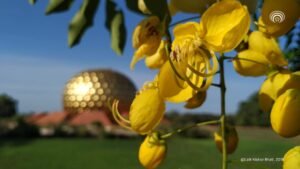
At the centre of Auroville’s planning stands the symbol of the Mother. A central presence surrounded by four aspects: wisdom, power, harmony, perfection. And each aspect that unfolds further into twelve attributes. These are often encountered first in brochures, posters, or introductory talks which are neatly arranged, beautifully explained and easy to admire.
But here, symbols are not meant to decorate ideas but to apply gentle pressure.
To live under the symbol is to feel its demands. Wisdom is not a concept; it tests the way decisions are made. Power is not authority; it asks how force is used or withheld. Harmony is not agreement; it challenges how conflict is held. Perfection is not flawlessness; it insists on sincerity of effort. Brochure-level understanding of these nuances reassures while lived-experience unsettles.
Symbols here are not meant to reassure but to insist on everyday efforts.
Green Belt as Necessity, Not Idealism
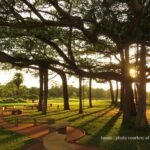
The green belt was not an aesthetic afterthought but a practical foresight. It is the land to grow food, a space to regenerate soil, a buffer against endless expansion and an attempt at self-sufficiency.
The Mother was often described as visionary, but she was also deeply practical. A city that could not feed itself was not free. A collective that depended entirely on external systems could not claim autonomy.
And yet, the gap remains. Growing food takes time, labour, knowledge and commitment across generations. Self-sufficiency is not achieved by intention alone.
Here again, the ideal meets resistance of land, climate and human consistency. The green belt stands as both necessity and reminder that consciousness does not bypass effort. Ideals work through effort.
Work as Karma Yoga: Why is this Difficult ?
One of the clearest principles given was that everyone must work: not as employment, but as offering. Work as Karma Yoga is action done without personal claim and bargaining for reward.
The ideal sounds simple. The lived reality is not.
Engineers may find themselves doing work far from their training. Doctors may lay marble floors. Farmers may work long hours with little visibility, while others design buildings or manage systems. The dignity of work is meant to be equal, regardless of form.
What makes this especially difficult is the absence of external enforcement. There is no authority compelling compliance and no hierarchy that guarantees fairness. Everything rests on goodwill and inner consent.
Here, nothing works by command and everything waits for willingness which is not constant. Willingness fluctuates with fatigue, expectation, comparison, and personal history. The work continues not because the system is perfect, but because enough people keep choosing to show up.
Money: The Question That Never Goes Away
Few topics return as persistently as money. The ideal is clear: money should not be the sovereign lord. Within the community, exchange is not meant to be transactional in the usual sense. Basic needs are to be covered. Contribution is not to be measured by income potential.
But Auroville does not exist outside the world. Materials come from outside. Services interface with external economies. Commercial units operate. People arrive with different financial backgrounds and capacities.
There is no final formula here but only continuous adjustment, attempts, corrections and the inevitable occasional frustration.
The difficulty is not money itself. It is human readiness, readiness to trust, to give without calculation, and to receive without entitlement. This readiness cannot be legislated but can only grow from within.
Education Beyond Certificates and the Cost of That Freedom
Education in Auroville was envisioned as integral addressing the psychic, mental, vital, and physical being. It was conceived to be a continuous journey of learning for the joy of learning, development without coercion, beauty as a foundation and not an extra.
Children are encouraged to grow freely and to discover rather than compete. Physical education is valued alongside mental development and the body is not neglected. Because in the end, transformation is not meant to bypass matter.
And yet, friction appears. Some children wish to study outside and degrees do matter in the wider world. Hence systems must interface with external structures without collapsing into them.
Education here is not a finished model. It is a living edifice which is always under construction and always evolving and never ending.
Free Will as the Only Authority
Perhaps the most demanding aspect of the experiment is this: nothing works unless it is chosen freely. There is no living guru issuing commands and neither a system that compels obedience nor any mechanism that guarantees alignment.
Everything depends on inner consent and on the willingness to do the right thing without reward, fear and external pressure. And this is both the strength and the weakness of Auroville.
Free will allows for genuine transformation but also comes with delay, avoidance, and resistance. Progress is uneven and relapses happen where nothing is automatic.Nothing here works unless someone chooses it freely and hence the choice must be renewed every day.
Housing, Belonging, and Letting Go of Ownership
In general housing may reveal commitment in concrete terms. Many residents have built their own homes, often with their own resources. And yet, these houses do not belong to them. They belong to the collective.
If someone leaves, the house remains without compensation or reclaiming. This is not framed as sacrifice but simply a condition of belonging. Hence the risk is real and the choice is not symbolic.
Such arrangements demand clarity and not everyone is ready for them. Often this is also acknowledged and not judged.
Youth, Not as Age, but as Pressure to Grow
The Mother spoke of a youth that never ages. Not biological youth, but an inner posture with a refusal to settle into repetition.
Auroville needs young people, yes. It also needs the energy of youth in those who have been here for decades. The willingness to keep questioning, adapting and to not defend forms simply because they are familiar is a basic requirement.
Youth here is pressure. A gentle pressure to grow while remaining open.
A Collective Experiment Without Guarantees
Auroville does not offer guarantees, be it success, comfort or harmony.
What it offers is a field where planning meets reality, vision meets habit, and goodwill is tested daily against fatigue and complexity.
Solutions emerge not from clarity alone, but from persistence. The experiment continues not because it is easy, but because people stay.
And perhaps the quiet question beneath all others should be if one is ready or wants to be part of a living experiment? Because what happens next depends less on the City’s plan, but more on who is willing to live inside its real difficulties.