Roger Anger is often spoken of in Auroville with a curious mix of reverence and frustration. His name surfaces whenever debates about planning, construction, zoning, roads, or “the original vision” become heated. For some, he represents lost coherence; for others, an outdated imposition. And yet, both positions miss the deeper point. Roger Anger did not come to Auroville to design a city in the conventional sense. He came to give form to an idea that could not yet fully exist.
To understand the Galaxy Plan, one must first understand the man behind it—not biographically in detail, but conceptually.
Roger Anger was a French architect trained in modernist traditions, deeply influenced by Le Corbusier, but equally dissatisfied with the limits of functionalist urbanism. He was not interested in efficiency alone, nor in aesthetics as surface beauty. What drew him to Auroville was something most planners never encounter: a city that explicitly stated consciousness as its foundation.
That sentence alone should give pause.
Cities are usually designed around economics, defence, trade, governance, or housing. Auroville proposed something radically different. It did not begin with infrastructure. It began with an aspiration—human unity, unending education, and a future-oriented consciousness. Anger understood immediately that such a city could not be planned like Chandigarh or Brasília. There was no precedent. What he was being asked to do was not to solve a technical problem, but to translate an inner principle into spatial form.
The Galaxy Plan emerged from this attempt.
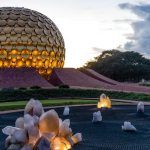
At its simplest, the Galaxy Plan proposes a circular city organised around a central point—the Matrimandir—radiating outward into zones: Residential, Cultural, Industrial, and International, all held within a green belt. But to describe it this way is to flatten it into a diagram, stripped of its intent. The form is not the essence. The movement is.
The plan is symbolic, not decorative; functional, not rigid. The circular geometry was never meant to aestheticise unity but to express it structurally. No front, no back. No privileged direction. No centre of power in the political sense, only a centre of concentration. From that centre, life was meant to flow outward in differentiated yet interconnected expressions.
This is where many misunderstandings begin.
The Galaxy Plan was never intended as a frozen blueprint. Anger himself resisted that idea repeatedly. He spoke of the plan as a framework that must evolve as consciousness evolves. The danger, in his view, was not deviation, but literalism. A city based on consciousness cannot be built mechanically. If form hardens faster than inner growth, the city becomes a shell.
This is why the oft-repeated question—“Why is Auroville still unfinished?”—is both valid and misplaced.
Yes, materially, Auroville is unfinished. Roads are incomplete. Infrastructure is patchy. Zones remain fragmented. But to read this solely as failure is to misunderstand the experiment. Auroville was never meant to be completed like a project handed over to a client. It was meant to grow organically, guided by an evolving inner orientation. That makes it slower, messier, and far more vulnerable to human inconsistency.
Anger knew this. In fact, he warned against the very tendency that now dominates debates around the plan: the urge to use it as a weapon.
Over time, the Galaxy Plan has been turned into a battleground. Some invoke it rigidly, as if any deviation were betrayal. Others dismiss it casually, as if it were merely a historical artefact. Both positions are distortions. The plan was neither law nor suggestion. It was a living hypothesis.
What Anger warned against most strongly was the reduction of the plan to a technical instrument divorced from its originating consciousness. He understood that without inner alignment, no amount of planning would hold. Infrastructure without shared orientation would fragment. Zones without lived meaning would become real estate. Roads without collective will would become lines on paper.
This is precisely what we see today.
The misuse of the Galaxy Plan in debates often reveals more about our anxieties than about the plan itself. When people cling to it rigidly, it is often because they fear chaos. When people reject it entirely, it is often because they fear constraint. But Anger’s vision was not about control or freedom in the abstract. It was about coherence.
Consciousness first.
Form second.
Infrastructure third.
Reverse that order, and the city loses its soul.
This hierarchy is deeply Aurobindonian, though Anger was not a philosopher. Sri Aurobindo repeatedly insisted that outer forms must follow inner change, not precede it. The Mother echoed this relentlessly. Anger, intuitively and architecturally, grasped the same principle. The Galaxy Plan was an attempt to hold space for a future consciousness—not to impose order on a present one.
This is also why the city feels perpetually unfinished. Auroville has grown faster in population and complexity than in shared inner discipline. Form has outpaced coherence. Infrastructure has been demanded before collective clarity has been achieved. The result is not failure, but tension—a city stretched between aspiration and actuality.
Anger did not underestimate this risk. He spoke openly about the danger of people using the plan to justify personal or ideological agendas. He feared the plan would be fetishised or instrumentalised, rather than lived. And in many ways, that fear has materialised.
Today, the Galaxy Plan is often reduced to lines on maps, legal arguments, or planning documents. Its deeper intent—to act as a reminder that the city must grow from an inner centre—is rarely engaged. The plan becomes either a stick to beat others with or a relic to be discarded.
Both miss the point.
Auroville’s problem is not that it has failed to implement the Galaxy Plan perfectly. Its problem is that it has not sufficiently internalised the principle behind it. Without that, no plan—however inspired—can function.
Roger Anger did not design certainty. He designed orientation.
He offered Auroville a way to think about itself as a living organism rather than a settlement. A city where movement mattered more than arrival. Where form was provisional, not absolute. Where the real work was not construction, but alignment.
Seen this way, the incompletion of Auroville is not simply a technical delay. It is a mirror. It reflects the unfinished state of the collective consciousness that inhabits it. That is uncomfortable to admit, but deeply honest.
If Auroville is to move forward, the Galaxy Plan must be rescued from both rigidity and neglect. It must be read again—not as a commandment, but as a question. What does coherence look like now? How does consciousness want to express itself today? What forms are still alive, and which have become habits?
Roger Anger cannot answer these questions for us. He never intended to. His contribution was not a solution, but a compass.
And a compass, if mistaken for a destination, becomes useless.
The tragedy would not be that the Galaxy Plan was never fully realised. The real tragedy would be forgetting that it was never meant to be.